

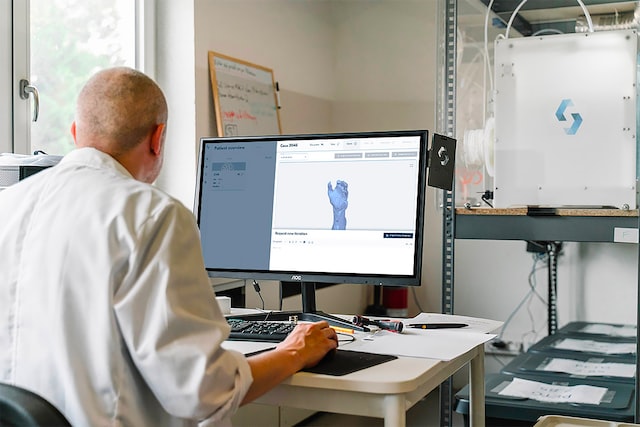
Industrial additive manufacturing is not a printer-centered process. It is a controlled chain that begins with product requirements and ends with an accepted, traceable part. Design, feedstock, build preparation, equipment, post-processing, inspection and configuration control all affect the final result.
The printer creates an as-built geometry. The manufacturing system creates the production part.
The end-to-end workflow
| Stage | Primary output | Main risk |
|---|---|---|
| 1. Requirements definition | Controlled part and acceptance requirements | Choosing AM before defining the engineering need |
| 2. Process and material selection | Candidate manufacturing route | Selecting a machine without a qualified material/post-process chain |
| 3. Design for AM | Manufacturable product definition | Ignoring supports, powder removal, machining and inspection |
| 4. Build preparation | Released build package | Uncontrolled orientation, parameters or file revisions |
| 5. Feedstock and equipment readiness | Traceable material and qualified machine state | Contamination, calibration drift or undocumented changes |
| 6. Build execution | As-built hardware and process records | Layer anomalies, thermal instability or incomplete data capture |
| 7. Recovery and post-processing | Finished or near-finished component | Distortion, damage, trapped powder or uncontrolled sequence |
| 8. Inspection and testing | Evidence of conformity | Using methods that cannot detect the credible defects |
| 9. Review and release | Accepted part and data package | Incomplete traceability or unresolved deviations |
1. Define the requirement before choosing the process
The workflow begins with function, not technology. Define loads, life, environment, interfaces, tolerances, surface condition, cleanliness, inspection, regulatory requirements, annual volume and cost targets. Identify critical-to-quality characteristics and credible failure modes.
AM should solve a specific problem such as internal-channel performance, part consolidation, low-volume tooling avoidance, expensive material savings, repair or supply-chain lead time. If the value proposition is unclear, conventional manufacturing may be the better route.
2. Select the complete process route
Process selection includes more than the printer. A production route combines:
- AM process category and machine platform
- Feedstock specification and supplier
- Qualified parameter set
- Build orientation and support strategy
- Heat treatment, HIP, debinding or sintering where required
- Support removal, cut-off, machining and finishing
- Cleaning, inspection, testing and release requirements
Material properties belong to this complete route. A familiar alloy name does not guarantee familiar wrought or cast performance.
3. Design for manufacturing, post-processing and inspection
Design for additive manufacturing must integrate the downstream operations. Review minimum walls and holes, overhangs, heat flow, residual stress, recoater interaction, powder escape, support access, machining allowance, fixture locations and inspection visibility.
Internal complexity should have a measurable purpose. A lattice or channel that cannot be cleaned, inspected or qualified can create more risk than value.
4. Create and control the build package
The released build package should identify the authoritative product definition and manufacturing configuration. Depending on the organization and process, it can include:
- Part model, drawing and revision
- Build orientation and location
- Supports, sacrificial features and machining stock
- Nesting and build layout
- Machine, software and parameter-set versions
- Required coupons, witness specimens and identifiers
- Post-processing and inspection travelers
- Approval status and electronic signatures
Native CAD, tessellated geometry, build files and machine files serve different purposes. Each transformation should be controlled so the manufactured configuration can be traced back to the released definition.
5. Verify feedstock and equipment readiness
Feedstock control can include chemistry, size distribution, morphology, flow behavior, moisture, contamination, lot identity and reuse history. Wire systems require chemistry, diameter, surface condition, cast, helix and storage controls. Bound-feedstock routes add binder condition and debinding behavior.
Equipment readiness includes maintenance, calibration, environmental controls, gas quality, filters, optics, recoaters, sensors, software status and machine acceptance. Operators should confirm that the machine is in the approved configuration before releasing the build.
6. Execute and monitor the build
During production, record the information needed to show what happened. Useful data may include machine state, parameter identification, oxygen or atmosphere history, alarms, layer images, recoater events, melt-pool signals, temperatures and operator interventions.
Monitoring does not automatically establish part acceptance. Sensor signals must be correlated with physical defects and production outcomes before they can support disposition decisions.
7. Recover the build safely
Build recovery includes cooling, powder removal, part identification, loose-powder handling and initial visual review. The sequence should protect personnel, preserve traceability and avoid damaging fragile geometry.
Powder trapped inside passages must be removed and verified according to the application. Reactive powders require controlled handling, housekeeping and waste procedures.
8. Apply post-processing in the controlled sequence
Post-processing can include curing, debinding, sintering, stress relief, solution treatment, aging, HIP, build-plate removal, support removal, machining, surface finishing, coating and cleaning. Sequence matters because each operation can change dimensions, residual stress, microstructure and defect visibility.
The approved route should define equipment, recipes, loading, atmosphere, fixtures, hold points and inspection stages. Subcontracted operations remain part of the controlled AM supply chain.
9. Inspect against credible failure modes
Inspection may combine dimensional metrology, visual examination, surface NDT, volumetric NDT, material testing, cleanliness verification and functional tests. The method must be capable of detecting the defect type, size and orientation that matter in the actual geometry.
Coupons can support process evidence but do not automatically represent every location or feature in the production part. Part-level inspection and process qualification should complement each other.
10. Review, disposition and release
Before release, verify that the part, manufacturing records and inspection results match the purchase order or internal specification. Deviations, repairs and concessions should be approved by the authorized functions and linked to the part record.
The final data package can include certificates, feedstock lot information, build record, heat-treatment charts, inspection reports, test results, nonconformance history and configuration identifiers. The depth of evidence should match the part class and application risk.
Where industrial AM programs usually fail
- Buying equipment before identifying a repeatable application pipeline
- Optimizing print time while ignoring post-processing capacity
- Using uncontrolled files or parameter copies
- Assuming machine monitoring replaces inspection
- Allowing undocumented feedstock, software or equipment changes
- Designing inaccessible channels, supports or machining features
- Qualifying coupons without demonstrating representative part capability
- Ignoring supplier and subcontractor configuration control
A practical release checklist
- The authoritative part revision and build configuration are identified.
- Feedstock lot and reuse history meet the approved requirements.
- The machine and software configuration were valid at build time.
- All planned manufacturing and post-processing operations are complete.
- Required process records and thermal charts are available.
- Inspection and testing meet the defined acceptance criteria.
- Nonconformances and deviations are dispositioned.
- Cleaning, powder removal and preservation requirements are satisfied.
- Marking and part identity match the records.
- The final data package is complete and retained.
Conclusion
The industrial AM workflow is a connected quality system. A stable printer process is necessary but insufficient. Production success requires requirements, design, feedstock, equipment, post-processing, inspection and data control to remain aligned from the first engineering decision through final part release.
Related Addithive resources: Introduction to Additive Manufacturing · Aerospace AM Qualification Guide
References and further reading
- ISO/ASTM 52920:2023 — Industrial AM processes and production sites
- ISO/ASTM 52901-17(2023) — Requirements for purchased AM parts
- ISO/ASTM 52927:2024 — Main AM characteristics and test methods
- ISO/ASTM 52951:2026 — Data packages for AM parts
Continue the analysis
Map the constraint: Interactive AM Bottleneck Graph
Companies to inspect: Nikon · Bodycote · Hexagon
Track changes: AM Company Signals · Company Database
Leave a Reply