Tag: quality control

  • To Insourse or to Outsource: A Dilemma of Additive Manufacture Parts

    To Insourse or to Outsource: A Dilemma of Additive Manufacture Parts

    12–18 minutes

    As we gaze upon the vastness of the manufacturing universe, we can observe a phenomenon that has been steadily gaining momentum in recent years: additive manufacturing. This process, more commonly known as “3D printing,” has seen a meteoric rise from a mere concept to a full-fledged technology capable of substituting parts and producing previously impossible geometries. However, as the technology continues to mature, a new debate has emerged: whether to insource or outsource the manufacturing of additive manufactured parts. In this article, we will explore the pros and cons of both options and the importance of post-processing for AM parts.

    First, let us examine the impressive ascent of additive manufacturing. The technology’s roots can be traced back to the 1980s when it was primarily used for prototyping. However, in recent years, 3D printing has transitioned from a novelty to a serious manufacturing tool. As additive manufacturing technology advances, it is being used for part-for-part substitution in a wide range of applications, from aerospace to medical devices. Additive manufacturing has revolutionized product design and manufacturing by enabling the production of parts with unique geometries that were once impossible to manufacture using traditional manufacturing methods. This newfound flexibility has allowed engineers and designers to create parts that are lighter, stronger, and more efficient, leading to significant performance improvements in a variety of industries.

    However, the manufacturing process for additive manufactured parts does not end with printing. Post-processing, which includes various operations such as finishing, polishing, and heat treatment, is crucial to achieving the desired properties and surface finish for the final product. Post-processing can also help to remove residual stresses and enhance the durability and longevity of the part. As additive manufacturing supply chains begin to develop, the sourcing of AM part building and their post-processing has become an unsettled and important issue.

    With this in mind, the debate between insourcing and outsourcing the manufacturing of additive manufactured parts has gained prominence. Insourcing refers to producing parts in-house, while outsourcing involves contracting the work to external suppliers. Each approach has its own set of advantages and challenges that must be weighed carefully before making a decision. Let us examine these factors in more detail.

    Advantages of Insourcing AM Parts

    As we ponder the insourcing vs. outsourcing debate, it is important to consider the advantages of each approach. Insourcing has several benefits that cannot be ignored. By producing additive manufactured parts in-house, manufacturers have complete control over the entire manufacturing process. This control allows for greater quality assurance, enabling manufacturers to ensure that their products meet strict standards. Additionally, in-house production provides a higher level of security and confidentiality, which is especially important for companies working with proprietary designs.

    Another significant advantage of insourcing is faster turnaround times and reduced lead times. In-house production allows for greater control over production schedules, which means that parts can be manufactured and delivered to customers more quickly. This is particularly important for industries such as aerospace and automotive, where production schedules are often tight and parts must be delivered on time to avoid delays and downtime.

    Insourcing also provides greater flexibility in terms of design changes and customization. With in-house production, manufacturers have the ability to quickly make changes to the design of the part, allowing for greater flexibility in the production process. This can be particularly valuable for companies that require customization or for those that are continually iterating on their designs.

    Finally, insourcing can be a more cost-effective option for high-volume production. By producing parts in-house, manufacturers can avoid the markups associated with outsourcing and can take advantage of economies of scale to reduce costs. This can be particularly beneficial for industries that require high-volume production, such as the automotive industry.

    Advantages of Outsourcing AM Parts

    As we explore the insourcing vs. outsourcing debate, it is important to consider the advantages of outsourcing as well. One of the most significant benefits of outsourcing is access to specialized expertise and equipment. Additive manufacturing is a rapidly evolving field, and outsourcing can provide manufacturers with access to the latest technology and techniques without the need for significant investment in research and development. Outsourcing can also provide access to specialized expertise, such as design and engineering support, which can be particularly valuable for companies that do not have in-house expertise.

    Another key advantage of outsourcing is lower upfront investment costs. By outsourcing the production of additive manufactured parts, manufacturers can avoid the need to invest in expensive equipment and facilities, allowing them to redirect resources to other areas of their business. This can be particularly beneficial for companies that are just getting started with additive manufacturing or for those that have limited resources to invest.

    Outsourcing also provides scalability for fluctuating demand. In industries where demand for parts can be unpredictable, outsourcing can provide manufacturers with the flexibility to scale production up or down as needed. This can be particularly valuable for companies that experience seasonal fluctuations in demand or that have variable production needs.

    Finally, outsourcing can reduce the risk of investing in unproven technology. Additive manufacturing is a relatively new technology, and investing in equipment and personnel can be risky for companies that are just starting out. By outsourcing, manufacturers can reduce their risk exposure while still taking advantage of the benefits of additive manufacturing.

    Challenges of Insourcing AM Parts

    As we delve further into the topic of insourcing AM parts, we must acknowledge the challenges that come with this approach. The first and perhaps most obvious challenge is the need for specialized equipment and expertise. Unlike traditional manufacturing methods, AM requires specific machinery and software to create parts layer by layer. This equipment can be expensive and may require significant upfront investment.

    Furthermore, there is a shortage of skilled workers with experience in AM technology. Insourcing AM parts requires personnel with knowledge of not only the equipment but also the software, materials, and post-processing techniques. Hiring and training these skilled workers can be time-consuming and expensive, adding to the overall cost of insourcing.

    Another challenge of insourcing AM parts is the potential for underutilized resources. AM equipment can be costly to operate and maintain, and it may take time to build up a large enough volume of work to justify the investment. Companies that insource may find themselves with underutilized equipment and personnel, leading to a loss of productivity and increased costs.

    Source: EOS | Application: Alphaform

    Finally, there is the challenge of sourcing materials and managing the supply chain. Insourcing AM parts requires access to high-quality materials, which may not be readily available. Companies that insource may also face challenges in managing the supply chain and ensuring a steady supply of materials and equipment.

    Despite these challenges, insourcing AM parts can offer significant advantages in terms of control, flexibility, and cost savings. Companies that are willing to invest in the necessary equipment and personnel can reap the benefits of faster turnaround times, greater design flexibility, and lower costs for high-volume production. However, it is important to carefully weigh the pros and cons of insourcing versus outsourcing and choose the approach that best meets the needs of the business.

    Challenges of Outsourcing AM Parts

    As with any outsourcing decision, there are potential challenges associated with choosing to outsource the manufacturing of AM parts. One major concern is the loss of control over the manufacturing process. When outsourcing, companies are putting their trust in a third party to produce high-quality parts that meet their specific requirements. This can be especially difficult when it comes to AM, as the technology is still relatively new and many suppliers may not have the same level of expertise as the company itself.

    Another potential issue with outsourcing AM parts is the potential for longer lead times and communication issues. When working with suppliers in different time zones or countries, there may be a delay in response times and scheduling conflicts that could lead to delays in the production process. Additionally, communication issues may arise due to language barriers or cultural differences.

    Quality control is also a concern when outsourcing AM parts. Companies need to ensure that their suppliers are producing parts that meet their specific requirements and that they are using high-quality materials. Intellectual property concerns are also important, as companies need to protect their designs and ensure that their suppliers are not using their designs for other purposes without permission.

    Finding reliable suppliers can also be a challenge when outsourcing AM parts. As the technology is still relatively new, there may not be as many suppliers available, and it may take some time to find a supplier that can meet the company’s specific needs. Additionally, there may be issues with supplier stability or consistency, which could lead to disruptions in the supply chain.

    Despite these challenges, outsourcing AM parts can still be a viable option for many companies. By working with a trusted supplier, companies can benefit from access to specialized expertise and equipment, lower upfront investment costs, and scalability for fluctuating demand. Ultimately, the decision to insource or outsource AM parts will depend on a variety of factors, including the company’s specific needs, resources, and capabilities.

    Factors to Consider When Deciding to Insourcing vs. Outsourcing AM Parts

    As we have seen, the decision between insourcing and outsourcing AM parts is not a straightforward one. Both approaches have their advantages and challenges, and the choice ultimately depends on a variety of factors specific to each organization.

    One important factor to consider is cost. Insourcing AM parts can result in lower costs for high-volume production, but requires a significant upfront investment in specialized equipment and expertise. On the other hand, outsourcing AM parts can result in lower upfront investment costs, but may lead to higher costs per part due to markup by the supplier.

    Another factor to consider is production volume and scalability needs. Insourcing may be more feasible for organizations with consistent, high-volume production needs, while outsourcing may be more suitable for those with fluctuating demand or limited production needs.

    In-house expertise and equipment are also important factors to consider. Insourcing may be more attractive for organizations with existing expertise and equipment in AM, while outsourcing may be a better option for those without the necessary resources or expertise.

    Source: EOS | Application: materialise

    Intellectual property concerns also play a role in the decision between insourcing and outsourcing AM parts. Insourcing can provide greater control over intellectual property, while outsourcing may expose organizations to greater risk of IP theft or infringement.

    Quality control and post-processing requirements are other important considerations. Insourcing provides greater control over the entire manufacturing process, including post-processing, while outsourcing may result in longer lead times and potential communication issues.

    Finally, supply chain resilience and risk management must be taken into account. Insourcing can reduce supply chain risks by eliminating reliance on external suppliers, while outsourcing may provide access to specialized expertise and equipment that may not be available in-house.

    Last Thoughts

    In conclusion, additive manufacturing has come a long way from being a tool for prototyping and concept testing to a full-fledged production method. The unique geometries and design possibilities of AM parts have made it a popular choice for a wide range of mobility OEMs. However, the question of insourcing vs. outsourcing the manufacturing and post-processing of AM parts remains unsettled.

    Insourcing provides greater control over the entire manufacturing process, faster turnaround times, flexibility in design changes, and lower costs for high-volume production. However, it requires significant upfront investment, specialized equipment and expertise, sourcing and training skilled labor, and the potential for underutilized resources.

    On the other hand, outsourcing provides access to specialized expertise and equipment, lower upfront investment costs, scalability for fluctuating demand, and reduced risk of investing in unproven technology. However, it may lead to loss of control over the manufacturing process, longer lead times, potential communication issues, quality control and intellectual property concerns, and difficulty in finding reliable suppliers.

    When making a decision on insourcing vs. outsourcing AM parts, several factors need to be considered, including cost considerations, production volume and scalability needs, in-house expertise and equipment, intellectual property concerns, quality control and post-processing requirements, and supply chain resilience and risk management.

    In light of these factors, careful consideration needs to be taken to make a decision that best fits the specific needs and circumstances of each organization. It is important to weigh the advantages and challenges of both options and make a decision that aligns with the organization’s goals and objectives.

    As additive manufacturing continues to evolve and expand, the decision to insource or outsource the manufacturing and post-processing of AM parts will continue to be a crucial one. Careful consideration and planning are essential to make the right decision that will ultimately benefit the organization in the long run.

    Case Studies

    Case studies are important to understand the benefits and challenges of insourcing and outsourcing additive manufacturing. Let’s take a look at some examples of successful and unsuccessful cases for both insourcing and outsourcing.

    Insourcing Case Study: BMW Group is a well-known brand in the automotive industry that has adopted additive manufacturing in its production process. The company has successfully implemented AM technology for manufacturing spare parts and tooling in-house. BMW has a dedicated AM department with a team of experts who design, produce, and post-process parts using AM technologies. By insourcing AM parts, BMW has reduced production time and cost, while maintaining control over the entire production process.

    Outsourcing Case Study: Boeing is one of the largest aerospace companies in the world, known for its high-quality aircraft. The company has outsourced some of its AM parts to external suppliers to leverage their expertise and gain access to specialized equipment. By outsourcing, Boeing has been able to reduce upfront investment costs and benefit from the suppliers’ experience and capabilities. For example, Boeing outsourced the production of titanium brackets for its Dreamliner aircraft to a third-party supplier, which resulted in significant cost savings.

    Insourcing Case Study: GE Aviation is a leading aircraft engine manufacturer that has implemented AM in its production process. The company has invested heavily in building its own AM capabilities and has created a dedicated AM facility that includes a range of machines and post-processing equipment. By insourcing, GE Aviation has gained control over the entire production process and has been able to produce parts faster and at a lower cost. GE Aviation has also used AM to produce complex, high-performance parts that cannot be made using traditional manufacturing methods.

    Outsourcing Case Study: Adidas is a well-known sportswear brand that has outsourced some of its AM parts to external suppliers. The company has collaborated with Carbon, a 3D printing company, to produce 3D-printed midsoles for its running shoes. By outsourcing to Carbon, Adidas has been able to leverage the company’s expertise in AM and gain access to its advanced 3D printing technology. This has allowed Adidas to produce high-quality, customized midsoles that offer superior performance to traditional midsoles.

    While these companies have successfully implemented insourcing and outsourcing strategies, there have also been some unsuccessful cases. One example is the failed collaboration between Airbus and Materialise, which led to the discontinuation of their partnership in 2016 due to difficulties in scaling up production. Another example is the production problems faced by Nike when they outsourced the manufacturing of their Flywire shoes to an external supplier, resulting in quality issues and delays.

    These case studies highlight the importance of carefully considering all factors when making the decision to insource or outsource AM parts. Factors such as cost, production volume, expertise, intellectual property concerns, quality control, and supply chain resilience should all be taken into account. By doing so, companies can make informed decisions and ensure successful implementation of additive manufacturing in their production processes.

    Potential Outsource Partners for Additive Manufacturing

    Stratasys: As one of the pioneers of additive manufacturing, Stratasys has been providing high-quality 3D printing services for over three decades.

    Materialise: With a focus on innovation and sustainability, Materialise offers a wide range of additive manufacturing services, including design, engineering, and post-processing.

    Adidas 4DFWD

    Proto Labs: Known for its rapid prototyping services, Proto Labs is a leading provider of on-demand manufacturing for a variety of industries.

    3D Systems: With a global network of facilities and a commitment to pushing the boundaries of 3D printing technology, 3D Systems is a top choice for outsourcing additive manufacturing.

    ExOne: Specializing in industrial-grade 3D printing, ExOne offers a range of services from prototyping to full-scale production.

    Velo3D: Leveraging advanced software and hardware, Velo3D is a top-tier provider of precision metal 3D printing services.

    SLM Solutions: With a focus on metal additive manufacturing, SLM Solutions offers a range of services for industries such as aerospace, automotive, and medical.

    Stratasys Direct Manufacturing: As the manufacturing arm of Stratasys, this company provides a variety of 3D printing and additive manufacturing services for a wide range of industries.

    EOS: With a commitment to sustainability and a focus on industrial applications, EOS is a leading provider of metal and polymer 3D printing services.

    HP Multi Jet Fusion: Leveraging HP’s expertise in inkjet technology, HP Multi Jet Fusion offers high-quality 3D printing services for both prototyping and production purposes.
  • Ensuring Quality in Additive Manufacturing: The Importance of Nondestructive Testing (NDT)

    Ensuring Quality in Additive Manufacturing: The Importance of Nondestructive Testing (NDT)

    Additive manufacturing (AM) technology, more commonly known as 3D printing, has seen a massive evolution in the past few years. From being used for prototypes and concepts, the technology has progressed to part-for-part substitution and the creation of unique, AM-specific part geometries. Today, these applications are increasingly present in demanding, mission-critical fields such as medicine and aerospace, where materials with specific thermal, stiffness, corrosion, and static loading properties are required. To advance in these arenas, metallic, ceramic, and polymer composite AM parts need to be free from discontinuities, and the manufacturing processes have to be stable, robust, and repeatable. And the nondestructive testing (NDT) technology and inspection methods will need to be sufficiently capable and reliable to ensure that discontinuities will be detected to prevent the components from being accepted for use.

    The AM technology has seen a tremendous evolution in the past few years, and its impact on manufacturing is substantial. It has opened up new possibilities in terms of design and has the potential to change how we think about manufacturing. With the ability to create unique geometries, manufacturers can now design and produce complex parts that would have been impossible to create using traditional manufacturing methods.

    But the technology’s advancement hasn’t come without its challenges, particularly when it comes to material quality. In critical industries like aerospace and medicine, where lives depend on the quality of the parts produced, there’s no room for error. The parts need to be free from discontinuities, and the manufacturing process has to be stable, robust, and repeatable to ensure quality. To ensure that AM parts are up to standard, NDT technology and inspection methods have to be reliable and capable enough to detect any discontinuities that might compromise the parts’ quality.

    In this blog post, we’ll discuss the impact of AM technology on critical industries like medicine and aerospace, the challenges manufacturers face in producing high-quality parts, and the role of NDT technology and inspection methods in ensuring that AM parts meet the required standards.

    AM Parts in Demanding Fields

    AM parts have come a long way from being used for prototyping and concepts. Today, these parts are increasingly used as part-for-part substitution in demanding fields like medicine and aerospace. In the medical industry, AM technology is used to produce patient-specific implants, surgical tools, and dental crowns, among others. These parts are designed to fit each patient’s unique anatomy, improving the success rates of surgeries and reducing the risk of complications.

    In the aerospace industry, AM technology is used to produce parts that can withstand the harsh environments of space, such as rocket nozzles and satellite components. These parts need to be strong, lightweight, and able to withstand extreme temperatures and pressures. AM technology allows manufacturers to produce parts with unique geometries that cannot be produced using traditional manufacturing methods, making it ideal for aerospace applications.

    The Importance of Material Quality

    In demanding fields like medicine and aerospace, where the quality of the parts produced can mean the difference between life and death, material quality is crucial. AM parts need to be free from discontinuities like porosity, cracking, and delamination, which can compromise the part’s structural integrity. Any discontinuities in the parts can result in catastrophic failure, which is unacceptable in critical applications.

    To ensure that AM parts are free from discontinuities, the manufacturing process has to be stable, robust, and repeatable. Manufacturers need to ensure that the parts are produced under optimal conditions to reduce the likelihood of discontinuities. The process needs to be controlled to ensure that each part produced meets the required standards.

    Nondestructive Testing (NDT) Technology and Inspection Methods

    NDT technology and inspection methods are essential in ensuring that AM parts meet the required standards. NDT is a method of evaluating the properties of a material, component, or system without causing damage or altering the material’s physical properties. NDT techniques can be used to detect any discontinuities in AM parts, ensuring that they are free from defects.

    There are several NDT techniques used in the industry, including radiographic testing, ultrasonic testing, magnetic particle testing, liquid penetrant testing, and eddy current testing. Each technique has its advantages and disadvantages, and the choice of technique depends on the type of material and the type of defect being detected.

    Radiographic testing, also known as X-ray testing, is commonly used to detect internal defects in metallic parts. The technique involves passing X-rays through the part being tested and capturing the resulting image on a film or digital detector. The resulting image can then be evaluated for any discontinuities, such as porosity or cracking. Radiographic testing, for example, is an effective technique for detecting internal defects in metallic parts. This makes it a useful tool for inspecting complex internal geometries that can be produced using additive manufacturing.

    Radiographic Testing via Bernoullies

    Ultrasonic testing is another commonly used NDT technique. The technique involves sending high-frequency sound waves through the material being tested and measuring the time it takes for the waves to bounce back. The resulting data can be used to evaluate the material’s properties, such as thickness, and detect any discontinuities, such as cracks. However, it is important to note that while ultrasonic testing may have limitations in inspecting complex geometries and rough surfaces of additive parts, it is still a widely used and effective NDT technique for detecting defects in a range of materials. Ultrasonic testing may not be the most suitable technique for inspecting all additive manufactured parts and that other NDT techniques may need to be used in conjunction with ultrasonic testing to ensure that all defects are detected.

    Ultrasonic Inspection via I, Plenumchamber

    Magnetic particle testing is used to detect surface and subsurface cracks in ferromagnetic materials. The technique involves applying a magnetic field to the part being tested and applying magnetic particles to the surface. The particles will be attracted to any areas where the magnetic field is distorted, indicating the presence of a crack. Like ultrasonic inspections surface roughness can be a problem in terms of inspectability and interpretation.it is important to consider the surface preparation of additive manufactured parts before performing NDT inspections to ensure accurate a

    nd reliable results.

    Magnetic Particle Inspection

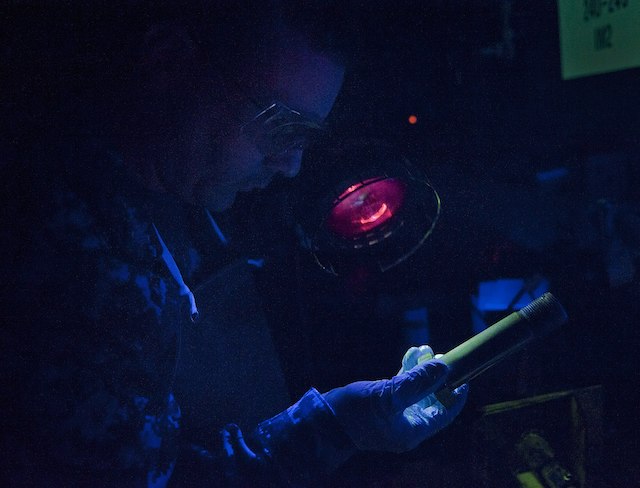
    Liquid penetrant testing is used to detect surface defects, such as cracks and porosity, in non-porous materials. The technique involves applying a liquid penetrant to the surface of the part being tested and allowing it to seep into any defects. The penetrant is then removed, and a developer is applied to the surface, highlighting any defects.Liquid penetrant testing is a widely used technique for detecting surface defects in non-porous materials. However, it is less suitable for use on porous materials such as metal foam or additively manufacture surfaces, where the penetrant can seep into the material and give false results. The technique is also limited to detecting defects that are open to the surface, making it less effective for detecting subsurface defects.

    Karl Deutsch Prüf- und Messgerätebau GmbH + Co KG

    Eddy current testing is used to detect surface and subsurface defects in conductive materials. The technique involves passing an alternating current through a coil, creating a magnetic field. The magnetic field will induce an electrical current in the part being tested, creating a secondary magnetic field. Any changes in the secondary magnetic field can be used to detect any discontinuities in the part.Eddy current testing is a non-destructive technique that can be used to detect surface and subsurface defects in conductive materials. It is particularly useful for detecting defects in thin-walled structures, such as those commonly produced using additive manufacturing. However, the technique is less effective on non-conductive materials such as ceramics and polymers.

    Stefan Trache – Visualization of Eddy Current Induction by Induction Coil

    Overall, the choice of NDT technique for additive manufactured parts will depend on a variety of factors, including the type of material being inspected, the type of defect being detected, and the cost and time constraints of the inspection process. By using the right NDT technique, manufacturers can ensure that their additive manufactured parts are free from defects and meet the demanding requirements of industries such as aerospace and medicine.

    Additive manufacturing technology has come a long way from being used for prototyping and concepts. Today, it is being used as part-for-part substitution in critical industries like medicine and aerospace, where the quality of the parts produced is crucial. To ensure that AM parts meet the required standards, they need to be free from discontinuities, and the manufacturing process has to be stable, robust, and repeatable. NDT technology and inspection methods are essential in detecting any defects in the parts, ensuring that they meet the required standards.

    As the technology continues to evolve, the industry will continue to face new challenges. The demand for high-quality parts will only increase, and manufacturers will need to adapt to meet these demands. With continued advancements in NDT technology and inspection methods, the industry can be confident in the quality of AM parts produced, paving the way for a future where AM technology is the go-to manufacturing method for critical applications.

    DT TechniqueAdvantagesDisadvantagesSuitable MaterialsSuitable Defects
    Radiographic TestingDetects internal defectsRequires special equipment and trained personnel; harmful to health and the environmentAll materialsPorosity, cracking
    Ultrasonic TestingNon-destructive; high accuracy and resolution; can detect both internal and surface defectsMay not be suitable for complex geometries and rough surfacesAll materialsporosity, cracks
    Magnetic Particle TestingDetects surface and subsurface cracks in ferromagnetic materials; relatively simple and cost-effectiveOnly suitable for ferromagnetic materials; surface preparation is critical; requires trained personnelFerromagnetic materialsSurface and subsurface cracks
    Liquid Penetrant TestingDetects surface defects in non-porous materials; simple and cost-effectiveOnly suitable for non-porous materials; requires proper surface preparation and cleaning; may produce false indicationsNon-porous materialsSurface defects such as cracks, porosity
    Eddy Current TestingDetects surface and subsurface defects in conductive materials; can detect small defectsOnly suitable for conductive materials; requires trained personnel; may produce false indicationsConductive materialsSurface and subsurface defects
    Note: The above table is a general comparison based on the advantages and disadvantages of each technique. The suitability of a particular technique for a specific application may depend on several factors, including the type of material, defect size and location, and the required level of accuracy and resolution.

    Related Addithive research: Aerospace Additive Manufacturing Qualification Guide

  • From Digital Design to Post-Processing: The Intricate Process of Additive Manufacturing

    From Digital Design to Post-Processing: The Intricate Process of Additive Manufacturing

    In our modern age, technology continues to change the way we create, design, and produce objects. One of the most transformative technological innovations in recent years has been additive manufacturing, commonly known as 3D printing. This revolutionary process allows us to create complex objects with remarkable precision and efficiency. In this article, we will take readers on a virtual tour of a 3D printing facility and provide an in-depth look at the various steps involved in creating a 3D-printed object, as well as the possible effects of each step.

    At the heart of the additive manufacturing process is the digital design file. The design file is the blueprint for the object and contains all the necessary information about its shape, size, and structure. The file is created using specialized software that allows designers to create objects in 3D, using either vector or polygonal modeling. The software also allows designers to manipulate and refine the design, making it suitable for printing. The design file is typically saved in one of several formats, including STL, OBJ, or AMF, which are compatible with 3D printers.

    The first step in the additive manufacturing process is the preparation of the design file for printing. This involves the use of software to “slice” the 3D model into layers, each of which is a cross-section of the final object. The software then generates instructions for the 3D printer on how to build each layer, including the placement and amount of material required for each layer. The slicing process is critical because it determines the accuracy, strength, and durability of the final product. It is also essential to ensure that the design is properly oriented to avoid structural issues, such as overhangs, undercuts, or warping.

    Before the printing process can begin, several important considerations must be taken into account. One of the most critical factors is material selection. 3D printers can use a wide range of materials, including plastics, metals, ceramics, and even food. Each material has its unique properties and limitations, and the selection of the appropriate material is crucial to ensure that the final product meets the desired specifications. For example, if the object is intended for outdoor use, it should be printed with a material that is UV-resistant and weather-resistant.

    Once the material has been selected, it is time to prepare the printing parameters. This involves setting the appropriate temperature, speed, and other variables that will affect the printing process. This step requires significant expertise and experience, as minor adjustments can have a significant impact on the final product’s quality. The printing parameters can also affect the printing time, as higher temperatures and faster speeds can result in quicker printing times but may sacrifice quality.

    With the printing parameters set, the 3D printer can begin the additive manufacturing process. The printer creates the object layer by layer, adding material where it is needed and leaving spaces where it is not. This process can take several hours or even days, depending on the size and complexity of the object. During the printing process, the printer must be closely monitored to ensure that the object is printed correctly and that no issues arise, such as material jams, nozzle clogs, or other errors. Any errors can result in a failed print or an object that does not meet the required specifications.

    After the printing process is complete, the object must undergo post-processing to achieve the desired finish and functionality. Depending on the application, this can involve a wide range of techniques, such as sanding, painting, polishing, or coating. These post-processing techniques are crucial to ensure that the final product is not only visually appealing but also meets the required functional specifications. For example, sanding can smooth rough surfaces, while coating can add strength or resistance to environmental factors.

    The post-processing step can also have significant effects on the final product’s durability and strength. For instance, polishing can help to reduce the object’s surface roughness, which can increase its resistance to wear and tear. Coating can also protect the object from environmental factors such as moisture, heat, or UV radiation. These post-processing techniques are essential to ensure that the final product is not only aesthetically pleasing but also meets the required functional specifications.

    Another critical consideration in the additive manufacturing process is quality control. This involves a series of tests and inspections to ensure that the object meets the required specifications and standards. Quality control can involve various techniques, such as visual inspection, dimensional analysis, or mechanical testing. These tests are necessary to ensure that the object is safe and reliable and that it meets the necessary regulations and standards.

    In addition to the practical applications of additive manufacturing, the process also has significant implications for design and creativity. Because 3D printing allows designers to create objects with remarkable precision and complexity, it opens up a whole new realm of creative possibilities. Designers can create objects that were previously impossible or too challenging to produce using traditional manufacturing methods. This can lead to new forms of artistic expression and innovation in fields such as architecture, product design, and jewelry making.

    Moreover, additive manufacturing also has environmental benefits, as it allows for more efficient use of materials and reduces waste. Traditional manufacturing methods often produce a significant amount of waste, as materials are cut, drilled, or carved to create the desired shape. In contrast, additive manufacturing only uses the necessary amount of material, which reduces waste and improves sustainability.

    In conclusion, additive manufacturing, or 3D printing, is a revolutionary process that has the potential to transform the way we create, design, and produce objects. From digital design to post-processing, each step in the additive manufacturing process has significant implications for the final product’s quality, durability, and functionality. The use of specialized software, material selection, printing parameters, post-processing techniques, quality control, and creativity all play critical roles in the process. Additive manufacturing has already revolutionized many industries, from healthcare to aerospace, and has the potential to continue to drive innovation and creativity in the years to come.