

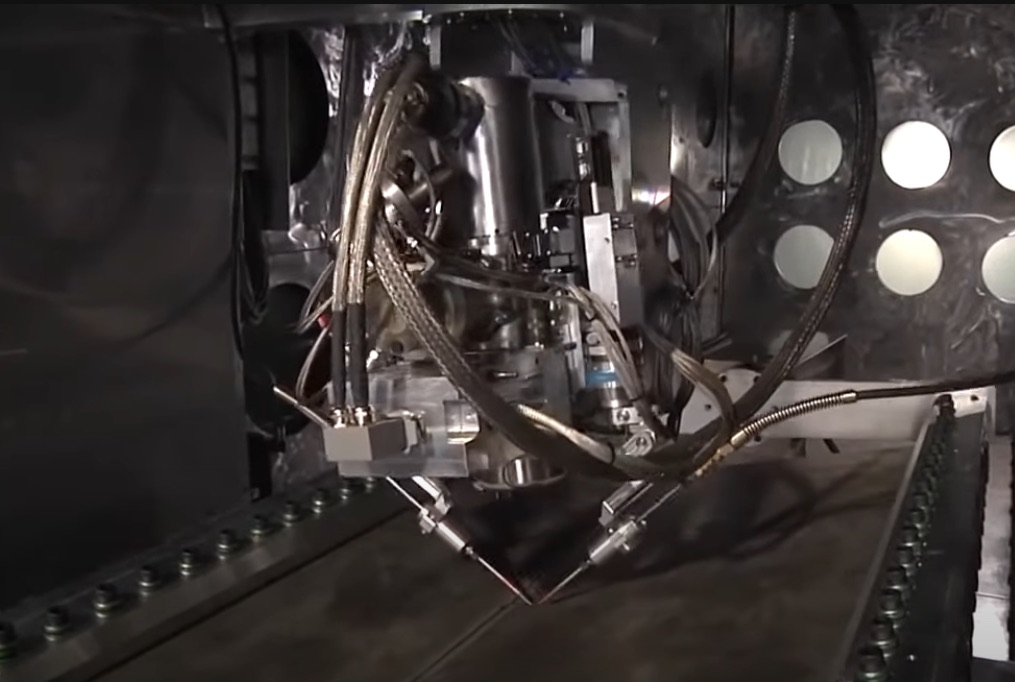
Wire-fed electron beam additive manufacturing is a directed energy deposition process in which an electron beam creates a melt pool and metallic wire is fed directly into it. The standardized process description is DED-EB/M using wire feedstock. “EBAM” is also widely used, but it is a trademarked commercial term associated with Sciaky.
This is not electron beam powder bed fusion. Wire-fed DED-EB is built for large near-net shapes, repair and high deposition rates—not fine powder-bed resolution.
How wire-fed DED-EB works
- Digital process planning: A CAD model is converted into deposition paths, layer strategy, machine motion and wire-feed instructions.
- Substrate preparation: The build plate, preform or repair component is cleaned, positioned and qualified for deposition.
- Vacuum generation: The work chamber is evacuated to permit stable electron-beam operation and reduce oxidation of reactive alloys.
- Melt-pool creation: The focused electron beam melts a controlled area of the substrate or previous layer.
- Wire deposition: Wire enters the melt pool while the beam, part or deposition head follows the programmed path.
- Layer or bead stacking: Beads are overlapped to create walls, features or large near-net preforms.
- Monitoring and correction: Beam power, wire feed, travel speed and melt-pool condition may be monitored and adjusted by the machine control system.
- Post-processing: The deposited shape is heat treated, inspected and machined to final geometry as required.
Process classification
ASTM F3187 defines directed energy deposition as a process in which focused thermal energy fuses material as it is being deposited. DED can use laser, electron-beam or arc energy and can use wire or powder feedstock. Wire-fed electron-beam systems are one branch of this larger process family.
| Process | Energy source | Typical feedstock | Environment | Best-known use |
|---|---|---|---|---|
| DED-EB/M | Electron beam | Wire | Vacuum | Large near-net preforms in high-value reactive metals |
| DED-LB/M | Laser | Powder or wire | Inert shielding or controlled enclosure | Repair, coatings, features and multi-axis deposition |
| DED-Arc/M | Arc plasma | Wire | Shielding gas or local enclosure | Large structures and high-rate deposition |
| PBF-EB/M | Electron beam | Powder bed | Vacuum | Complex smaller parts, implants and selected aerospace hardware |
Why wire feedstock matters
Wire is generally easier to handle than fine reactive powder and can provide high material-delivery rates. It is available in established welding-alloy specifications for many metals, although AM production still requires control of chemistry, diameter, cleanliness, cast, helix, spool identity and storage.
Wire-fed deposition converts stock directly into a near-net shape, but it does not eliminate waste. Start/stop regions, run-on and run-off features, machining allowance, rejected builds and removed substrate material remain part of the yield calculation.
Main advantages
High deposition rate
Commercial systems can deposit several kilograms per hour, with rate strongly dependent on alloy, geometry, quality requirements and machine configuration. Gross deposition rate should not be confused with finished-part throughput. Vacuum cycle, cooling, inspection, heat treatment and machining can dominate total lead time.
Large build envelope
DED-EB can produce structures far larger than typical powder-bed machines. The practical limit is set by chamber size, motion system, thermal control, wire access and the ability to machine and inspect the deposited shape.
High-value material savings
The strongest economic case often occurs when a large titanium, nickel, tantalum or other expensive-alloy part would otherwise be machined from a very large forging or billet. A near-net DED preform can reduce buy-to-fly ratio and shorten raw-material lead time.
Repair and feature addition
Because feedstock is delivered into a local melt pool, DED can add material to existing components or preforms. Repair acceptance requires a defined damage-removal route, substrate condition, interface design, heat treatment and inspection plan.
Main limitations
- Low geometric resolution: Bead width and layer height are much larger than powder-bed features.
- Machining dependency: Critical surfaces, datums, holes and interfaces are normally finish machined.
- Thermal distortion: Large heat input and long deposition paths can cause warping and residual stress.
- Bead stability: Wire position, transfer behavior, melt-pool size and path transitions affect consistency.
- Vacuum infrastructure: Chamber size, pump-down time, seals and maintenance affect cost and availability.
- Limited access: The beam and wire must reach the deposition location without collision or shadowing.
- Qualification burden: Large components are expensive to test destructively and difficult to inspect volumetrically.
- Microstructure variation: Thermal history can vary across thick intersections, starts, stops and long builds.
Design for wire-fed DED-EB
- Design near-net, not net-shape. Define machining allowance from process capability and distortion evidence.
- Use accessible geometry. Ensure the beam, wire and motion system can reach each feature.
- Control section transitions. Abrupt mass changes create thermal accumulation and path-planning difficulty.
- Plan deposition sequence. Bead order, direction and dwell time influence distortion and microstructure.
- Create machining datums. Include robust features for setup, probing and final coordinate transfer.
- Include run-on and run-off strategy. Starts and stops may require sacrificial material.
- Design for inspection. Avoid large uninspectable volumes unless process evidence and risk analysis justify them.
- Consider hybrid substrates. Deposit only where AM creates value and retain forged, plate or machined material elsewhere.
ISO/ASTM 52922, a design standard for metal DED, was still under development in 2026. ASTM F3413 provides existing design guidance for DED and should be interpreted together with application-specific engineering requirements.
Materials
Wire-fed DED-EB is especially attractive for reactive or high-value alloys that benefit from vacuum processing:
- Titanium and titanium alloys
- Nickel-based superalloys
- Tantalum, niobium and selected refractory metals
- Selected steels and other weldable alloys
Weldability is a useful starting point but is not sufficient. The route must control dilution, segregation, solidification cracking, phase transformation, chemistry pickup and heat-treatment response.
Multi-wire and graded materials
Some systems can use dual wire feeds to increase deposition or vary chemistry. This creates potential for graded composition and custom alloy development, but it also introduces major control questions:
- How are the two feed rates calibrated and synchronized?
- Is mixing within the melt pool uniform and repeatable?
- Can local chemistry be verified throughout the part?
- Do intermediate compositions form brittle phases?
- How will the material be specified, heat treated and qualified?
Multi-material capability should therefore be treated as a material-development program, not a routine printer option.
Process monitoring and control
Key variables include beam power, focus, travel speed, wire-feed rate, wire position, melt-pool geometry, layer height and machine motion. Commercial platforms may use cameras or thermal sensing to adjust deposition conditions.
Closed-loop control can reduce variation, but it does not automatically prove internal quality. Sensor calibration, latency, field of view, data retention and correlation with physical defects remain essential.
Typical imperfections
| Imperfection or condition | Potential contributors |
|---|---|
| Lack of fusion | Low energy, poor bead overlap, wire misalignment or contaminated interface |
| Porosity | Wire condition, unstable transfer, entrapped gas or melt-pool turbulence |
| Cracking | Alloy susceptibility, thermal gradient, restraint and composition changes |
| Bead-shape variation | Wire feed, beam power, travel speed, surface condition and local heat buildup |
| Distortion | Deposition sequence, substrate restraint, heat input and cooling |
| Interface defects | Oxide, contamination, insufficient dilution or inadequate surface preparation |
| Chemistry variation | Evaporation, feedstock variation, cross-contamination or multi-wire imbalance |
ASTM work on a standardized DED imperfection classification was still underway in 2026. Until acceptance frameworks mature, the inspection plan should be based on credible process-specific failure modes and representative demonstration hardware.
Post-processing and inspection
- Stress relief, solution treatment, aging or HIP as required
- Removal from the substrate or retention as a hybrid component
- Rough and finish machining
- Surface finishing and cleaning
- Dimensional inspection
- Surface and volumetric NDT selected for geometry and defect orientation
- Material testing from qualified witness locations
Very large parts can exceed practical CT capacity. Ultrasonic, radiographic, surface and local destructive methods may need to be combined with process qualification and monitoring.
Applications
- Aerospace structures: large titanium preforms, tanks, frames and structural features
- Defense: low-volume, long-lead, high-value metal hardware
- Energy: large nickel, refractory or specialized-alloy components
- Repair and remanufacturing: restoration or addition of high-value features
- Material development: controlled composition experiments using multiple wires
Economics
The economic comparison should be against the complete conventional route, often a large forging plus extensive machining. Include:
- Wire and substrate cost
- Vacuum and deposition cycle
- Engineering and path development
- Build failures and qualification hardware
- Heat treatment and HIP
- Machining time and removed material
- Inspection and documentation
- Raw-material and tooling lead-time reduction
DED-EB is strongest where the alternative has a very high buy-to-fly ratio, long forging lead time, low production volume and expensive alloy. It is weak for small precision components that can be produced efficiently by powder bed, casting or machining.
Selection checklist
- Is the part large enough and valuable enough to justify DED?
- Can the geometry be created as accessible overlapping beads?
- Is suitable wire available with controlled quality and supply?
- Can the deposited material be heat treated and qualified?
- Is sufficient machining stock included?
- Can the complete volume and interfaces be inspected?
- Does the facility have vacuum, handling and safety capability?
- Does accepted-part cost beat forging, fabrication or alternative DED routes?
Conclusion
Wire-fed electron beam DED is a high-rate near-net-shape process for large, high-value metal components. Its advantage comes from combining vacuum processing, wire feedstock and large-scale deposition. Its limitations—coarse geometry, thermal management, machining and qualification—must be included from the first design decision.
Related Addithive resources: Electron Beam Powder Bed Fusion · Wire Arc Additive Manufacturing
Leave a Reply