

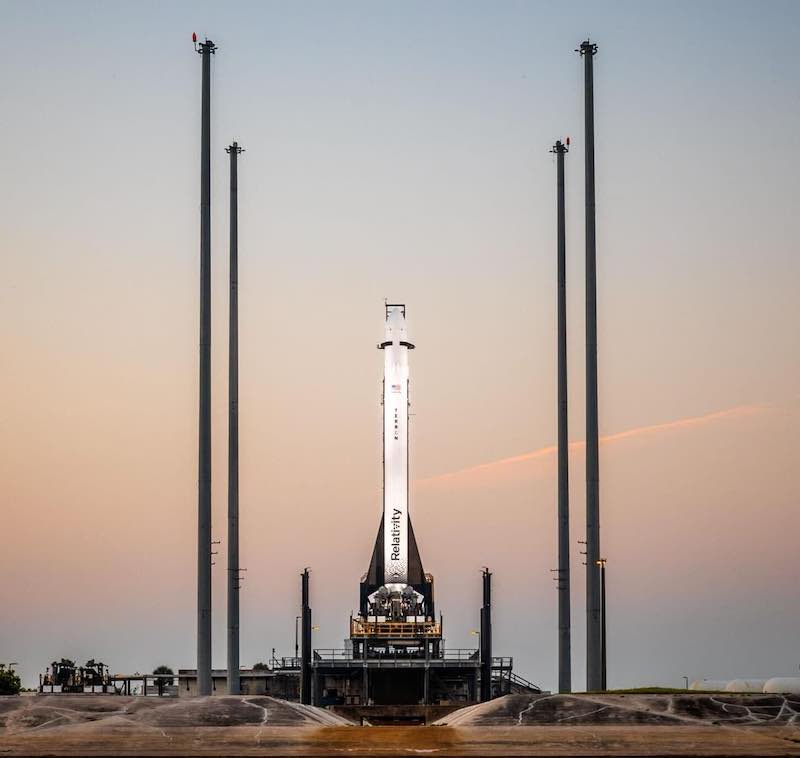
Relativity Space writing the history by launching the world’s first 3D printed rocket, the Terran 1. This groundbreaking achievement will be a significant milestone in the aerospace industry and represents a revolutionary shift in the way we design and build rockets.
Traditionally, rocket manufacturing has been a complex and expensive process that involves a large number of parts and specialized equipment. But with 3D printing, the potential to simplify this process and make it more cost-effective is enormous. Relativity Space has leveraged this potential to create a rocket that goes from raw material to flight, integrating artificial intelligence, robotics, and autonomous manufacturing technology.

The Terran 1 is not only a technological marvel, but it also marks a significant shift in the aerospace industry. With 85% of its mass being 3D printed, the rocket’s primary structures are printed using a proprietary metal aluminum alloy developed in-house by Relativity. This enables the company to radically simplify the aerospace manufacturing supply chain, leading to greater flexibility and customization.
The rocket is an expendable two-stage launch vehicle powered by liquid natural gas (LNG) and liquid oxygen (LOX) designed for future constellation deployment and resupply. It can launch up to 1,250 kilograms to low Earth orbit (LEO) for dedicated, multi-manifest and rideshare missions. With nine 3D printed Aeon 1 engines on the first stage and one 3D printed Aeon Vacuum (Vac) engine on the second stage, the rocket is 110 feet in height by 7.5 feet in diameter.
The Aeon engines are fueled by liquid natural gas and liquid oxygen, utilizing the gas generator engine cycle. The tanks are autogenously pressurized with gaseous natural gas and gaseous oxygen via heat exchangers integrated into the engines. Relativity Space’s Stargate metal 3D printers enable rapid product iteration, unlocking significant improvements to product development and production.
The potential of 3D printing in the aerospace industry is vast. The ability to print rocket parts on-demand can revolutionize the way we design and build rockets. With 3D printing, we can reduce the time it takes to produce rocket parts, reduce the cost of manufacturing, and increase the efficiency of the manufacturing process. This could lead to faster and more cost-effective space exploration.
Relativity Space is building a highly attractive launch service offering by designing and manufacturing reusable rockets that offer high performance and reliability, while costing less to produce and fly. The company’s innovative approach to aerospace manufacturing is driving the inevitable shift toward software-defined manufacturing, which will drive innovation on and off planet Earth.

The Terran 1 launch is just the beginning of a new era in space exploration. With 3D printing and other advanced manufacturing technologies, we can revolutionize the way we explore space. The potential of additive manufacturing is vast, and we are excited to see what the future holds for this innovative technology.
3D printing is not only a game-changer for rocket manufacturing but also for spacecraft components, satellites, and other equipment used in space exploration. This could lead to more cost-effective and efficient space missions, making it easier to explore our solar system and beyond.
At Addithive, we are excited to see Relativity Space and other companies pushing the boundaries of what is possible with additive manufacturing. We believe that 3D printing has the potential to change the world, and we are thrilled to see how it will transform the aerospace industry and beyond.
The Terran 1 launch is a testament to the potential of additive manufacturing to revolutionize the industry. The rocket is not only a technological marvel but also a symbol of a significant shift in the way we think about space exploration. We are excited to see what the future holds for
Leave a Reply