

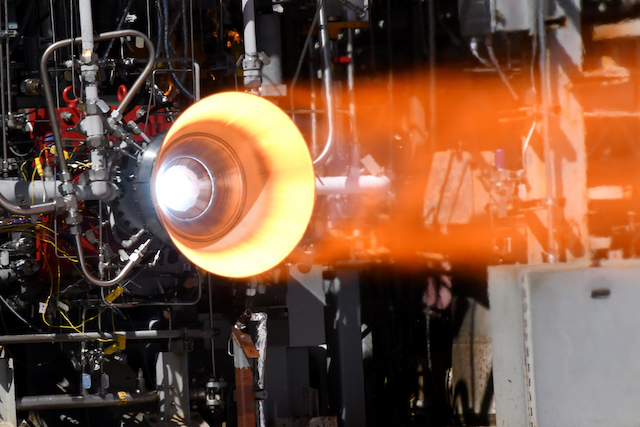
The space industry is a great field for new technology development. The challenges such as lightweight and stronger components with the demand for higher trust and lighter rockets that can reach mars propel the demand for more advanced components. Emerging technologies are almost always initiated in space or defense industries because the demand for the better originates in these industries either by war or competition in the industry. Additive Manufacturing is also incepted in the aerospace industry and there are several great examples Large rockets, aircraft engines, satellites are all requires lighter and stronger parts. and the good thing is that the production volume for industrialization of these components way lower than the automotive industry. This makes these platforms a disruptive opportunity.
Additive manufacturing provides faster cycle time and leaner production of testing components for a space platform program. This both the design cycle of the components and the overall schedule of the development programs. Another advantage of additive manufacturing for space components is the reduction of complexity. Additive manufacturing enables the complexity of the component while reducing the complexity of the overall realization of the component. Combining several sub-parts into a combined assembly that can be built by additive manufacturing. We will go over some of the recent advancements that are developed by different NASA research centers. We will go over Rocket engine component examples that are developed with additive manufacturing technology such as injectors, turbopumps, combustion chamber and more. These advancements are great examples and paves the way to new space age for reaching Mars and beyond.
Rocket Engine Injectors
Rocket Engine fuel injectors are simple but one of the most critical of a rocket engine because it defines the theoretical performance of the rocket nozzle. A well-designed injector enables efficient burning of the propellant. In addition to that, injectors help to reduce the thermal loads on the nozzle by cooling the internal nozzle surface with fuel. Injectors can be made by drilling small holes with a designed pattern that fuel and oxidizers travel. The holes break the fuel into small droplets, smaller the droplets burned easily and the efficiency of the combustion increased. The holes are can be drilled in conventional ways but it is costly when compared to additive manufacturing. Rocket engine injector successfully tested at NASA Glenn research center Rocket combustion lab with a benefit of lead time from 1 year to 4 months and 70% less cost. The main cost out opportunity is to reduce the number of parts. The additive injector has 2 parts, while its conventional version has 115 parts. This is a disruptive reduction for both cost, program execution, and simplification of the supply chain.

Rocket Engine Turbopumps
Rocket Engine Turbopumps produce high-pressure propellant to feed rocket engine combustion chamber. These pumps are designed with turbo-machinery principles and the design of these components is as hard as a jet engine yet a well-designed turbopump can deliver 70–90% efficiency. This particular turbopump makes 90000 revolutions per minute (RPM) to pump propellant. NASA has developed a turbopump in 2015 for liquid hydrogen, which is an ideal propellant for space missions but it is pumped at -240 Celcius. Rocket engine turbopump has 45% fewer parts. Combining several parts into one complex additive part dramatically reduces both costs and the weight of the component. On top of that reducing the number of parts simplifies the supply and realization of the hardware.

Gimbal Cone
There are many methods to change the exhaust direction of the rockets. One of the methods is to use a gimbal system. A gimbaled nozzle tilts the engine nozzle in the proper direction. Below Gimbal cone made of titanium at ORNL, The process used for this component is Electron Beam Melting. When compared to investing casting or other conventional manufacturing methods. The manufacture of titanium components like this gimbal has a great potential to reduce costs as well as lead time and overall weight of the component. Titanium alloys are expensive yet they provide lightweight and strong components. Especially Ti-6Al-4V is a great alloy for rockets, jet engines, and satellites. Of Course, there are challenges like material properties and how are these are changing with the variation of process features. Powder Process microstructure relations are complex and need to be investigated.

Rocket Engine Combustion Chamber
Rocket fuel and oxidizer flow in to combustion chamber with the help of turbo pump since the pressure inside the combustion chamber is extremely high. The combustion chamber mixes oxidizer and the fuel. The temperatures inside of the combustion chambers is over 2750 Celcius. This is far more than the melting temperature of copper alloy. In order to protect the chamber from melting during this extreme operation, It is being cooled by the extremely low temperature (-173 Celcius ) gas circulation inside the 200 tiny channels. These channels can only be manufactured by additive technology. It takes more than 10 days to build this rocket component but it is way faster than to manufacture it with conventional ways. Copper is a good heat conducter and this makes it a great match for this application. However, it makes it hard to melt with a laser scan. Overcoming these obstacles is not easy but enables game change rocket engines.

Structural Jacket using EB FFF (Free Form Fabrication)
Copper combustor liners are good for thermal conductivity but they are not very strong. In order to solve this problem, it is covered with an IN625 (Nickel Alloy) structural jacket. Electron Beam Free Form Fabrication is a directed energy deposition technology. In this technique Electron Beam is used as energy source and it is directed to melt metal wires which are IN625 for this application. It is a very fast process that is developed by Sciaky Inc to deliver 5kg/hour. EB FFF technology derived from Electron Beam welding process which has been used in aerospace industry more than 50 years. One of the challenges of this process it works under vacuum since electron beam can only be generated by vacuum.

Rapid Analysis and Manufacturing Propulsion Technology (RAMPT) :
NASA is working on Rapid Analysis and Manufacturing Propulsion Technology (RAMPT) to advance novel design and manufacturing technologies while increase scale, reduce cost, and improve performance of rocket engine components. Key focus areas of the program as below :
- Directed Energy Deposition (DED) focusing on blown powder techniques to enable integrated cooled channel wall nozzle.
- Multi material additive manufacturing modalities such as bimetallic and multi-metallic deposition techniques focusing on copper and nickel based super alloys.
- Engineering and simulation tools to predict and compensate material feed techniques distortion and material properties
- Last but not least development of design tools to get full benefit of additive enables design which primarily focuses on integrated cooled combustion chamber and nozzle

Conclusion
Additive manufacturing is a great tool to reduce weight and cost while improving perfomance. This is exact need for the space technology and next generation rocket engines. Several different additive modalities under investigatin by NASA and these will be utilized on space programs. we observe and extensive use of additive manufacturing technology on space propulsion componentst. There are still problems and issues to advance the technology such as certification of components and development new alloys suitable for additive manufacturing. However these issues are also good opportunities for additive manufacturing industry partners, universities and material producers.
References :
Additive Manufacturing of Aerospace Propulsion Components -Dr. Ajay Misra, Dr. Joe Grady and Robert Carter – NASA Glenn Research Center Cleveland, OH – Doc: 20150023067 – https://ntrs.nasa.gov/citations/20150023067
Lightweight Thrust Chamber Assemblies using Multi- Alloy Additive Manufacturing and Composite Overwrap – Paul R. Gradl , Chris Protz John Fikes, Allison Clark NASA Marshall Space Flight Center, Huntsville, AL Laura Evans , Sandi Miller6, David Ellis NASA Glenn Research Center, Cleveland, OH Tyler Hudson NASA Langley Research Center, Hampton, VA
Leave a Reply