

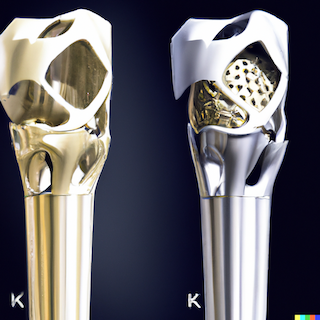
Medical additive manufacturing includes several very different activities: anatomical models, surgical guides, standard implants, patient-matched devices, prosthetics, instruments and early-stage bioprinting research. Each application has a different risk profile, evidence burden and manufacturing route.
A material described as biocompatible is not automatically a safe medical device. The intended use, finished geometry, manufacturing process, cleaning, sterilization and clinical performance must be evaluated together.
Medical AM application map
| Application | Typical value | Main controls |
|---|---|---|
| Anatomical models | Visualization, education and surgical planning | Image segmentation, dimensional accuracy and intended-use labeling |
| Surgical guides | Transfer a digital plan to the patient during a procedure | Fit, guide geometry, sterilization and procedural validation |
| Patient-matched implants | Geometry adapted to a patient’s anatomy | Imaging data, design boundaries, mechanical performance and traceability |
| Standard porous implants | Repeatable lattice or porous structures for fixation | Process validation, fatigue, residue removal and biological evaluation |
| External prostheses and orthoses | Customization, comfort and rapid iteration | Fit, load capacity, skin contact and durability |
| Instruments and fixtures | Complex geometry and low-volume production | Cleaning, sterilization, strength and lifecycle testing |
| Drug and biologic research | Novel dosage forms, scaffolds and laboratory models | Application-specific drug or biologic regulation |
| Bioprinting research | Cellular constructs and research models | Cell viability, biology, vascularization and translational evidence |
Standard designs vs patient-matched devices
Not every medical AM part is patient specific. Many commercially manufactured spine cages, orthopedic implants and instruments are produced repeatedly from standard designs. Patient-matched devices use imaging or anatomical data to create a defined variation within an approved design envelope.
Personalization increases the importance of software validation, segmentation review, design rules and data traceability. A unique geometry does not remove the requirement for controlled manufacturing or device testing.
The patient-specific digital workflow
- Acquire patient data: CT, MRI, optical scan or another validated source is collected at appropriate resolution.
- Segment the anatomy: Relevant structures are separated from the medical image and reviewed for artifacts or missing information.
- Create the device or model: The design is generated within approved rules, offsets and anatomical interfaces.
- Clinical and engineering review: Qualified personnel confirm intended use, fit, orientation and critical features.
- Prepare the build: Orientation, supports, nesting and process parameters are released.
- Manufacture and post-process: Printing, cleaning, heat treatment, machining, finishing or curing are performed under controlled instructions.
- Inspect and test: Identity, geometry, material and functional requirements are verified.
- Clean, package and sterilize: The validated route is completed where required.
- Release and retain records: The part is linked to patient, design, software, machine, material and processing history.
The FDA describes a similar chain covering device design, software workflow, material controls, printing, post-processing, validation and testing.
Process and material selection
| Process | Common medical role | Important limitations |
|---|---|---|
| Metal laser powder bed fusion | Titanium, cobalt-chromium and selected implant or instrument applications | Residue, surface condition, fatigue, heat treatment and NDT |
| Electron-beam powder bed fusion | Selected titanium implants and porous structures | Powder-cake removal, feature resolution and platform-specific material routes |
| Polymer powder bed fusion | Models, instruments, orthoses and selected devices | Powder reuse, moisture, porosity and sterilization compatibility |
| Vat photopolymerization | Models, guides, dental devices and selected patient-contact products | Resin identification, washing, post-cure, extractables and aging |
| Material extrusion | Models, prosthetics, fixtures and research devices | Anisotropy, porosity, dimensional accuracy and cleaning |
| Material jetting | Multi-color or multi-material anatomical models | Material aging, support removal and limited structural performance |
| Bioprinting platforms | Research constructs, tissues and disease models | Biological complexity and early translational maturity |
Design and manufacturing controls
The FDA’s final guidance on additively manufactured medical devices organizes technical considerations around design/manufacturing and device testing. A practical control plan should address:
- Device orientation and build location
- Minimum feature capability and dimensional compensation
- Support removal and inaccessible surfaces
- Feedstock or resin specifications and lot control
- Machine, software and parameter validation
- Heat treatment, HIP, washing, post-curing and machining
- Process monitoring and change control
- Worst-case geometry and build configuration
- Part identification and patient-data linkage
- Supplier and production-site controls
Cleaning and residue removal
Complex AM geometry can trap powder, uncured resin, support material, solvent or process debris. Cleaning validation should consider the actual device geometry rather than an easily accessible test coupon.
- Define internal passages, pores and lattices that can retain residue.
- Validate the cleaning process at worst-case locations.
- Measure extractable or recoverable residue using appropriate methods.
- Control cross-contamination between materials and patient-specific jobs.
- Confirm that cleaning does not damage surface, dimensions or material properties.
- Retain evidence linking cleaning parameters to the released device.
ASTM F3335 provides guidance for assessing residue removal from powder-bed-fusion medical devices and is recognized by the FDA.
Biocompatibility and material claims
Biocompatibility is assessed for the finished device in its intended contact condition. Relevant variables can include:
- Base chemistry and additives
- Powder reuse or resin aging
- Build orientation and surface area
- Heat treatment, post-cure and cleaning
- Residual particles, monomers, solvent or support material
- Coatings, polishing and machining
- Contact type, location and duration
A resin or alloy cleared or used for one application should not be assumed acceptable for another indication or contact type.
Sterilization and dimensional stability
Sterilization can alter polymer dimensions, mechanical properties, surface condition and residual chemistry. Metal devices can also be affected by packaging, cleaning or repeated processing. The selected method—such as steam, radiation or gas—must be compatible with the finished device and its intended lifecycle.
- Measure dimensions and function after the complete sterilization route.
- Evaluate repeated cycles for reusable devices.
- Confirm that packaging permits effective sterilization and protects the device.
- Control time between manufacturing, cleaning, sterilization and use.
- Use the same post-processing condition for performance and biological testing.
Mechanical and functional testing
Test methods should represent the actual device, loading and manufacturing route. Depending on the application, evidence can include:
- Static strength and fatigue
- Wear, corrosion and fretting
- Porous-structure characterization
- Dimensional and fit verification
- Pressure, flow or leak performance
- Sterilization and shelf-life effects
- Usability and procedural performance
- Biological evaluation and clinical evidence as required
ASTM F3604-23 provides a framework for validating laser-powder-bed-fusion production systems used for medical devices, including machine qualification, software, raw materials and IQ/OQ/PQ concepts.
Point-of-care manufacturing
Hospitals and clinical centers may use 3D printing for models, guides or other devices. Point-of-care location does not remove manufacturing responsibility. Governance should define:
- Who is the legal manufacturer?
- Who approves segmentation and design?
- Which software, printer and material combinations are validated?
- How are maintenance, environmental conditions and operators controlled?
- How are patient data, cybersecurity and privacy protected?
- How are nonconformances and adverse events handled?
- Which records are retained and for how long?
Bioprinting: promising research, different maturity
Bioprinting uses cells, biomaterials or biologically active materials to create research constructs. It should not be grouped with commercially mature metal implants or surgical guides. Major challenges include cell viability, vascularization, tissue maturation, reproducibility, immune response and long-term function. Claims about printing complete transplantable organs remain research-stage rather than routine clinical manufacturing.
Medical AM readiness checklist
- The intended use and regulatory classification are defined.
- Design inputs and patient-matching boundaries are controlled.
- The exact material, machine and post-process route is validated.
- Worst-case geometry can be cleaned and inspected.
- Finished-device biocompatibility and sterilization are addressed.
- Mechanical and functional testing represents final condition.
- Software, imaging and segmentation are verified.
- Traceability links patient, design, build, material and processing records.
- Changes to site, machine, software or material trigger defined review.
- Clinical claims match the available evidence.
Conclusion
Medical additive manufacturing is already mature in selected areas such as hearing aids, dental workflows and porous metal implants, while other areas remain developmental. Success depends on matching the process to a defined medical need and validating the complete finished-device route—from patient data and design through cleaning, sterilization, testing and traceability.
Related Addithive resources: Dental Additive Manufacturing · Straumann Dental AM Profile · NDT for AM
Leave a Reply