Category: Company Intelligence

Company-focused additive manufacturing exposure, earnings, strategy, capacity, qualification and investor research.

  • Impossible Objects Shatters 3D Printing Speed Limits with the Launch of CBAM 25

    Impossible Objects has made a groundbreaking announcement, revealing their revolutionary CBAM 25 3D printer, capable of printing fifteen times faster than the closest competitor. Set to be unveiled at the RAPID + TCT tradeshow in Chicago next month, this innovative 3D printer will have a significant impact on the world of mass production and industrial applications.

    Impossible objects CBAM Slice
    Impossible objects CBAM Slice

    The CBAM 25 will become commercially available in early 2024, promising to bring 3D printing into the realm of volume manufacturing. By breaking the speed barrier, the CBAM 25 will deliver advanced materials with superior mechanical properties and tolerances, providing manufacturers with an unprecedented advantage over existing technologies.

    Robert Swartz, Founder and Chairman of the Board at Impossible Objects, stated, “The CBAM 25 is the world’s fastest printer, and we are entering a new era of 3D printing with nearly unlimited material options at the speed of true mass production. This is a Moore’s law moment for 3D printing, and this is just the first step.”

    The CBAM 25 utilizes high-performance composite materials, enabling engineers to design stronger, lighter, and more durable parts. Notably, the Carbon Fiber PEEK material set offers high chemical and temperature resistance and mechanical properties superior to most engineering plastics. Carbon Fiber PEEK parts are a suitable alternative for aluminum, tooling, spares, repairs, and end-use parts.

    Impossible objects CBAM Layer
    Impossible objects CBAM Layer

    Impossible Objects is currently producing and selling parts in untapped 3D markets such as electronic tooling and for a broad range of applications, including aerospace, defense, and transportation industries. It is also replacing CNC machining with greater geometric freedom.

    Steve Hoover, Impossible Objects’ CEO, emphasizes the importance of production speed with the new CBAM 25, stating, “With a fifteen times speed improvement over existing 3D printers, our new CBAM 25 completes the transition of 3D printing from its roots in prototyping to the heartland of manufacturing.”

    Impossible objects CBAM Machine
    Impossible objects CBAM Machine

    The CBAM 25 is indeed a giant leap forward, pushing 3D printing into volume manufacturing, and opening new opportunities for industries to reshape and rethink their manufacturing processes.

    The launch of the CBAM 25 marks a turning point for 3D printing, demonstrating the potential for exponential advancements in speed, material capabilities, and applications. For readers interested in learning more about this revolutionary technology, we recommend attending the RAPID + TCT tradeshow in Chicago, where the CBAM 25 will be unveiled. Additionally, stay informed on the latest developments in the 3D printing industry by following Impossible Objects and other leading companies.

    By embracing the CBAM 25 and its potential, businesses can optimize their manufacturing processes, reduce costs, and create innovative products that push the boundaries of what’s possible in the world of 3D printing.

  • Five Additive Manufacturing Companies to Watch in 2023 — Historical List

    Five Additive Manufacturing Companies to Watch in 2023 — Historical List

    This company list is preserved as a 2023 snapshot

    This article originally described Carbon, Desktop Metal, Formlabs, Xometry and Velo3D as five disruptive additive manufacturing startups. The framing is no longer reliable as a current market guide.

    The list mixed private companies, public companies, manufacturing marketplaces and equipment providers at very different stages of maturity. Ownership, financial condition, product strategy and public-market status have also changed since publication.

    Why the original startup label became misleading

    Company in the 2023 articleWhy a current reader needs new research
    CarbonA private production-platform company whose product, material and customer position should be evaluated from current company and customer evidence
    Desktop MetalIts ownership and operating status changed materially after the 2023 article
    FormlabsA mature private AM platform company rather than an early-stage startup in the ordinary sense
    XometryA public digital-manufacturing marketplace with AM as one of several production processes
    Velo3DA public metal-AM equipment company whose investment case depends on current revenue, cash, margins and installed-base execution

    For example, Nano Dimension completed its acquisition of Desktop Metal in April 2025. Nano Dimension later reported Desktop Metal in discontinued operations following bankruptcy and deconsolidation. This illustrates why old company lists should not remain positioned as evergreen market research.

    How Addithive evaluates companies now

    • AM exposure: how much of the business genuinely depends on additive manufacturing
    • Value-chain position: equipment, materials, software, services, post-processing or end-user adoption
    • Bottleneck ownership: whether the company controls a constraint required for AM to scale
    • Commercial proof: repeat orders, qualified production and customer concentration
    • Economics: gross margin, cash burn, recurring revenue and capital intensity
    • Platform durability: service network, installed base, material ecosystem and switching costs
    • Ownership and investability: public listing, parent-company exposure and transaction risk
    • Valuation and downside: the difference between a strong technology and an attractive security

    Current research starting points

    Transaction references

    Archive status: This URL is retained for historical reference and existing external links. It is not a current startup ranking, recommendation or investment list.

  • 3D Printing Stocks in 2023 — Archived Investment List

    3D Printing Stocks in 2023 — Archived Investment List

    This 2023 stock list is no longer a current investment universe

    This article originally reviewed a group of additive manufacturing and 3D-printing stocks using information available in April 2023. It is now preserved as a historical market snapshot.

    Several companies in the original list were acquired, taken private, delisted, restructured or materially changed their additive-manufacturing exposure. The original descriptions and ticker references should not be used for current investment decisions.

    Examples of changes since publication

    Company from the original articleMaterial change after the 2023 snapshot
    SLM SolutionsNikon completed the squeeze-out and made Nikon SLM Solutions a wholly owned subsidiary in 2023; it is no longer a standalone public AM stock.
    Fathom Digital ManufacturingCORE Industrial Partners completed a take-private acquisition in 2024.
    Desktop MetalNano Dimension completed the acquisition in April 2025. Nano Dimension later reported Desktop Metal in discontinued operations following bankruptcy and deconsolidation.
    MarkforgedNano Dimension completed the acquisition in April 2025 and announced an agreement in May 2026 to sell Markforged to Stratasys.
    Nano DimensionThe company’s investment case and AM asset structure changed substantially through acquisitions, divestiture plans and a proposed strategic combination.

    These examples are sufficient to make the original static list unsuitable as an evergreen investment guide. Current research must start from today’s ownership, listing, segment reporting and financial statements.

    Why “3D-printing stock” is an imprecise category

    The original article mixed several fundamentally different exposures:

    • Pure-play printer and materials companies
    • Digital manufacturing marketplaces and service bureaus
    • Software companies with limited AM revenue exposure
    • Diversified industrial companies with small AM divisions
    • Acquired companies that no longer trade independently
    • Companies whose primary value proposition changed after publication

    A better investment universe separates companies by business model, AM revenue exposure, value-chain role and ownership of an industrial bottleneck.

    The current Addithive classification

    BucketWhat it capturesPrimary investor question
    Core or pure-play AMCompanies whose economics depend heavily on additive manufacturingCan the platform reach durable margins and repeat production?
    Equipment and process platformsPrinter, deposition and production-system providersIs installed-base growth converting into recurring revenue?
    Materials and feedstockPowder, wire, polymer, resin and specialty-material suppliersDoes qualification create pricing power or switching cost?
    Software, simulation and digital threadDesign, build preparation, MES, monitoring and quality toolsHow material is AM to the wider software business?
    Services and digital manufacturingContract production and manufacturing marketplacesCan the business generate attractive utilization and gross margins?
    Post-processing and qualityHeat treatment, HIP, machining, metrology and inspectionDoes the company own a constraint that grows with AM adoption?
    Industrial adoptersAerospace, medical, dental, energy and automotive usersDoes AM create product or cost advantage large enough to affect earnings?

    What investors should verify now

    1. Current listing and ownership: Confirm ticker, exchange, parent company and transaction status.
    2. AM revenue exposure: Separate real AM sales from a broad advanced-manufacturing narrative.
    3. Revenue quality: Distinguish equipment shipments, services, consumables, software and recurring revenue.
    4. Installed-base economics: Measure utilization, service attachment and material pull-through.
    5. Cash and dilution: Review burn rate, financing needs and share issuance.
    6. Customer evidence: Look for qualified production and repeat orders rather than demonstrations.
    7. Gross margin and scale: Test whether growth improves economics or increases operating losses.
    8. Bottleneck ownership: Identify whether the company controls software, feedstock, post-processing, qualification or another scarce capability.
    9. Transaction risk: Account for acquisitions, asset sales, strategic reviews and delisting risk.
    10. Valuation: A useful AM technology does not automatically make an attractive stock.

    Current Addithive research

    Primary transaction references

    Archive status: This URL is retained for historical reference and existing external links. It is not investment advice or a current stock list.

  • Conflux and Rocket Factory Augsburg Join Forces to Develop Aerospace Heat Exchangers

    Conflux and Rocket Factory Augsburg Join Forces to Develop Aerospace Heat Exchangers

    The future of aerospace heat exchangers just took a giant leap forward as Conflux Technology, an Australian metal additive manufacturing (AM) leader, announced a partnership with German-based Rocket Factory Augsburg (RFA). Together, they aim to integrate Conflux’s cutting-edge heat exchangers into the gas ducts of orbital rockets. The project is part of the Australian Space Agency’s Moon to Mars Initiative: Supply Chain Capability Improvement Grant Program, which is providing $1 million AUD in grant funding for the development and manufacturing of this game-changing 3D printed heat exchanger.

    IMAGE: Rocket Factory Augsburg

    Aerospace Heat Exchangers: A New Frontier

    Heat exchangers play a crucial role in the efficient functioning of rocket engines, managing the immense heat generated during a launch. Conflux’s innovative 3D printed heat exchangers offer precise control over internal geometries, enabling optimized heat transfer and pressure drop. This partnership with RFA will push the boundaries of heat exchanger technology, leveraging Conflux’s expertise in developing and commercializing 3D printed thermal solutions for extreme applications.

    The Road to Moon and Mars

    The Supply Chain Capability Improvement Grant Program is an essential component of the Australian Space Agency’s Moon to Mars Initiative. This initiative aims to support Australian organizations in developing projects that could contribute to NASA’s ambitious plans for lunar and Martian exploration. By partnering with RFA, Conflux is positioning itself at the forefront of the rapidly expanding space industry, bolstering Australia’s space capabilities and strengthening its position on the global stage.

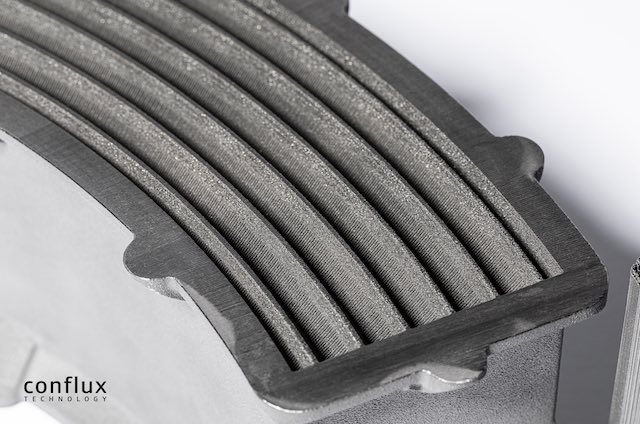
    Conflux Technology Monel K test part and close up.

    The 3D Printing Process

    To bring this project to fruition, Conflux and RFA will focus on the materials qualification and testing of Monel 500K, a high-performance alloy known for its excellent mechanical properties and resistance to extreme temperatures. The production platform for the heat exchangers will be the EOS M300-4, a state-of-the-art metal 3D printing system. The goal is to develop, build, and functional test the Gas Duct Heat Exchanger in 2023.

    A Pioneering Partnership

    This collaboration between Conflux and RFA is a testament to the transformative potential of additive manufacturing in the aerospace industry. By combining their respective expertise in 3D printing and rocket engineering, they are poised to create advanced heat exchangers that could redefine the performance and efficiency of future space missions.

    As the space race heats up, this groundbreaking partnership between Conflux Technology and Rocket Factory Augsburg stands as an exciting development for both the Australian and global space industries. The integration of advanced 3D printed heat exchangers into orbital rockets promises not only to improve performance but also to propel us closer to the ambitious goals of lunar and Martian exploration.

    via Conflux Technology

  • Desktop Metal and CETIM Qualify 304L Stainless Steel for 3D Printing on Shop System™: A Step Forward in Additive Manufacturing

    Desktop Metal and CETIM have announced the successful qualification of 304L stainless steel for use on the Shop System™. This new development complements the suite of stainless steel materials already qualified on the mid-sized binder jet printer, including 17-4PH and 316L.

    304L stainless steel is noteworthy for its high tensile strength, corrosion resistance, and durability, making it ideal for a wide range of applications, such as structural components, food processing equipment, fluid transfer components, and welded components. This new qualification means that it is now possible to produce complex geometries of 304L parts on demand with little to no waste, whether in low or high volumes.

    Desktop Metal Shop System via Desktop Metal

    CETIM, in collaboration with Desktop Metal, worked on the parameter development for 304L, enabling the material to be offered on the Shop System binder jet 3D printing system. The aim of this collaboration is to support quick production of critical replacement parts in the French energy sector, such as those used in fuel processing and nuclear components. This will help to reduce lead times for critical 304L maintenance parts, avoiding long and expensive downtimes in the factory.

    Christophe Reynaud, Ph.D., Additive Manufacturing Material Engineer at CETIM, stated that “304L is a key material in the energy sector due to its corrosion resistance, suited for highly demanding environments such as civil nuclear applications. Coupled with the high versatility and responsiveness of the Shop System, it is now possible to considerably reduce the lead-time for critical 304L maintenance parts.”

    This qualification of 304L stainless steel adds to the Shop System material portfolio, which now includes 17-4PH and 316L, IN625, and Cobalt-Chrome. IN718 is now fast-tracked for final development on Shop.

    Ric Fulop, Founder and CEO of Desktop Metal, said, “This new material offering will allow manufacturers to produce complex geometries of 304L parts on demand with little to no waste, whether they are interested in low or high volumes. 304L is a flexible, widely used stainless steel across many industries, and we’re delighted to offer it in our affordable, popular Shop System model.”

    The 304L stainless steel printed with the Shop System and sintered in an Ipsen graphite furnace meets or exceeds the minimum tensile properties and the chemical composition outlined in the ASTM A240 standard. Further development is underway to further qualify binder jet 3D printed 304L for use in food-processing equipment applications and for applications involving welding.

    Desktop Metal Shop System Part via Desktop Metal

    CETIM works closely with industrial companies to help identify market opportunities and facilitate innovation and technical progress. They were one of the first adopters of the Shop System, the Production System™ P-1, and also own a Desktop Metal Studio System™, a Bound Metal Deposition (BMD) metal printing system.

    In conclusion, the qualification of 304L stainless steel for use on the Shop System™ is a significant development for the additive manufacturing industry. This new material offering will enable manufacturers to produce complex geometries of 304L parts on demand, with little to no waste, whether in low or high volumes. The collaboration between Desktop Metal and CETIM has made it possible to reduce lead times for critical 304L maintenance parts, avoiding long and expensive downtimes in the factory. The addition of 304L to the Shop System material portfolio complements the suite of stainless steel materials already qualified, including 17-4PH and 316L, IN625, and Cobalt-Chrome, making the Shop System an affordable, popular option for manufacturers across many industries.

  • Nano Dimension’s Admaflex130 3D Printer Installed at NASA’s Marshall Space Flight Center for Sodium-Ion Battery Project

    Nano Dimension’s Admaflex130 3D Printer Installed at NASA’s Marshall Space Flight Center for Sodium-Ion Battery Project

    The landscape of 3D printing is in a perpetual state of evolution, and with each new advancement comes a wave of thrilling innovations. One such breakthrough that has captured the imagination of tech enthusiasts worldwide is the recent announcement that Nano Dimension has installed its state-of-the-art 3D printing system at NASA’s Marshall Space Flight Center. The system will be an integral component of a project aimed at 3D printing sodium-ion batteries, and Nano Dimension’s printer will play a pivotal role in ensuring the project’s success.

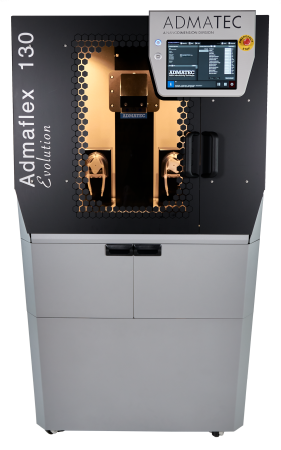
    Nano Dimension is a leading purveyor of cutting-edge 3D printing technology, specializing in Additively Manufactured Electronics and multi-dimensional polymer, metal & ceramic Additive Manufacturing 3D printers. The Admaflex130, which is the printer in question, is an outstanding product that was acquired in July 2022 from Admatec Europe B.V. This remarkable device possesses the capacity to produce a wide variety of materials, including ceramics and metals, with an astonishing degree of precision. Its Digital Light Processing (DLP) technology makes it ideal for research and development projects and 24/7 digital serial production of functional parts requiring complex geometries, high resolution, fine details, and smooth surface finishes, while maintaining exceptional material properties.

    What sets the Admaflex130 apart from the crowd is its unparalleled flexibility, allowing users to design bespoke materials and customize all printing parameters. This versatility is especially vital in research projects such as the one currently being undertaken at NASA. The efficacy of the project is contingent on the ability to print the sodium-ion batteries with exactitude, and the Admaflex130’s capacity for high-precision printing will undoubtedly prove invaluable.

    Admaflex130 – Nano Dimension

    The installation of Nano Dimension’s 3D printer at NASA’s Marshall Space Flight Center represents a significant milestone in the 3D printing industry. It speaks volumes about the printer’s reliability and quality, and NASA’s decision to trust it implicitly is a ringing endorsement of its capabilities. It also underscores the growing importance of 3D printing in research and development projects, particularly within the aerospace industry.

    Yoav Stern, Chairman and Chief Executive Officer of Nano Dimension, expressed his delight at the installation, saying, “It is difficult to imagine collaborating with an organization that is pushing the envelope of space exploration as comprehensively as NASA. We are immensely proud that they have chosen the Admaflex130 from Nano Dimension. Our team took a risk in developing a printer that could print multiple materials while maintaining open parameter settings, and they achieved remarkable success. We are confident that this system will empower NASA’s pioneering leaders to manufacture innovative applications. And who knows? Perhaps one day soon, we will see one such application making its way to Mars.”

    The installation of Nano Dimension’s 3D printing system at NASA’s Marshall Space Flight Center marks a turning point in the aerospace industry’s use of 3D printing technology. 3D printing has the potential to revolutionize the manufacturing process of various aerospace components, including engine parts, turbine blades, and even entire rocket engines. Moreover, 3D printing technology can help reduce the weight of these components, a crucial consideration for spaceflight, as every gram counts.

    NASA has been using 3D printing technology to manufacture parts for its spacecraft since the 1990s, but with recent advancements, we are only now beginning to see the technology’s true potential. The installation of Nano Dimension’s 3D printing system at NASA’s Marshall Space Flight Center is just one example of how 3D printing technology is being used to push the boundaries of what is possible in space exploration. With this cutting-edge technology, NASA can now rapidly produce complex parts that would have been difficult or impossible to manufacture using traditional methods. This not only saves time and money, but also enables NASA to create custom parts on-demand, reducing the need for large inventories of spare parts. Furthermore, 3D printing technology allows NASA to experiment with new designs and materials, which could lead to lighter, stronger, and more efficient spacecraft in the future. As the technology continues to evolve, we can expect to see even more exciting applications of 3D printing in space exploration and beyond.

    via Nano Dimension