

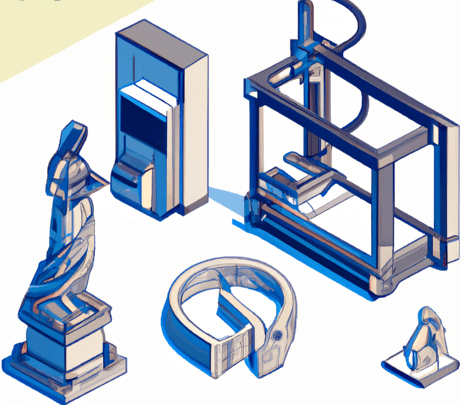
The history of additive manufacturing is not a single invention story. It is a sequence of advances in photopolymers, powder processing, extrusion, digital geometry, machine control, materials and qualification. The modern industry emerged when these elements became reliable enough to create repeatable physical parts directly from digital data.
The most important shift was not from “no 3D printing” to “3D printing.” It was from rapid prototyping to controlled manufacturing of accepted end-use parts.
Before modern AM: layered representation and automated fabrication
Long before commercial 3D printers, inventors and researchers explored ways to reconstruct three-dimensional form from cross-sections, projected images and automated deposition. Nineteenth-century photosculpture and topographic layering anticipated the idea of building a shape from sequential slices, but these methods were not digital additive manufacturing in the modern industrial sense.
Science-fiction descriptions in the mid-twentieth century also imagined machines that created objects from drawings or deposited material. These stories influenced the cultural imagination, but the technical foundations required computer-aided geometry, numerical control and suitable material systems.
1980–1981: Hideo Kodama and layered photopolymer models
Hideo Kodama described an automatic method for fabricating three-dimensional plastic models using a photo-hardening polymer. His Japanese work and patent record from 1980–1981 are among the earliest documented modern approaches to forming 3D objects by successively curing layers from cross-sectional data.
Kodama’s work demonstrated the central architecture of vat photopolymerization: digital sections, controlled light exposure and successive solid layers.
1984–1986: stereolithography becomes a commercial platform
Charles W. Hull filed a foundational stereolithography patent in 1984. The system used radiation to selectively solidify layers in a fluid medium according to cross-sectional information. Hull later co-founded 3D Systems, helping turn stereolithography from a laboratory concept into a commercial rapid-prototyping platform.
This period established several ideas that still define AM workflows:
- Represent the object as digital cross-sections.
- Build the geometry sequentially.
- Use computer-controlled motion and energy delivery.
- Separate digital design from physical tooling.
- Use support and post-processing to complete the part.
1986 onward: selective laser sintering
Carl Deckard’s selective-sintering work at the University of Texas used a laser to selectively consolidate regions of a powder layer. The foundational patent record has a 1986 priority date. Powder-bed processing expanded AM beyond liquid photopolymers and created a path toward durable polymer parts and later a broad family of metal powder-bed systems.
One major advantage was that surrounding powder could support complex shapes, reducing the need for attached supports in polymer systems. Powder handling, thermal control and material reuse became new industrial challenges.
1989 onward: material extrusion and FDM
S. Scott Crump’s foundational extrusion patent has a 1989 priority date and describes creating three-dimensional objects by dispensing material layer by layer. Stratasys commercialized the process under the Fused Deposition Modeling trademark.
Material extrusion later became the dominant architecture of low-cost desktop printing. Outside the trademarked term FDM, Fused Filament Fabrication became a common generic description for filament-based systems.
1989–1990s: MIT and three-dimensional printing by binder jetting
Researchers at the Massachusetts Institute of Technology developed a process that spread powder and selectively deposited binder to join chosen regions. The foundational patent family has a 1989 priority date and used the phrase “three-dimensional printing.”
This work became the basis for binder jetting across visual models, ceramics, metal parts and printed sand molds or cores. It also helped popularize “3D printing” as a broader public term.
The 1990s: rapid prototyping becomes an industry
During the 1990s, stereolithography, selective laser sintering, material extrusion, binder-based systems and material jetting became commercial rapid-prototyping tools. The main value proposition was speed: engineering teams could evaluate geometry before investing in molds, dies or production tooling.
This era also exposed limitations that remain relevant:
- Digital models needed repair and reliable file translation.
- Machine-specific build preparation became necessary.
- Supports, curing, depowdering and finishing affected lead time.
- Prototype material properties often differed from production materials.
- Accuracy and surface quality depended on process and orientation.
Metal AM expands
Metal additive manufacturing developed through several routes rather than one technology:
- Laser powder bed fusion: selectively melts metal powder using a laser.
- Electron-beam powder bed fusion: processes conductive metal powder under vacuum with a hot bed.
- Directed energy deposition: delivers powder or wire into a laser, arc or electron-beam melt pool.
- Metal binder jetting: prints a green part followed by depowdering, debinding and sintering.
- Sheet lamination: bonds metal foils, including ultrasonic solid-state routes.
The rise of metal AM shifted the industry from shape demonstration toward materials engineering, metallurgy, defect control, heat treatment, machining, NDT and qualification.
2004–2008: RepRap and open-source desktop printing
Adrian Bowyer introduced the RepRap concept online in 2004. The goal was a freely available rapid-prototyping machine able to manufacture many of its own plastic parts. The project combined open-source hardware, software and community collaboration.
In May 2008, the RepRap project documented a working “child” machine assembled using parts produced by a parent machine. RepRap did not invent extrusion printing, but it helped democratize it and seeded a large ecosystem of desktop printers, slicers, firmware projects and community-designed machines.
The 2010s: patents expire and access expands
As key early patents expired, competition increased in desktop and industrial systems. Entry-level machines became less expensive, while industrial platforms added better process control, multiple energy sources, larger build volumes and more capable software.
The decade also produced a sharp contrast between consumer hype and industrial reality. Desktop printers became widely visible, but reliable production still required process knowledge, controlled materials and post-processing.
Medical, dental and hearing-aid industrialization
Medical and dental applications demonstrated that AM could support large-scale customization when digital workflows and validated materials were tightly controlled. Hearing-aid shells, orthodontic models, surgical guides, dental devices and porous orthopedic implants became important examples.
The lesson was broader than healthcare: customization can scale when unique geometry flows through a standardized production cell.
Aerospace and propulsion: from demonstration to qualified hardware
Aerospace adoption focused attention on part consolidation, complex internal passages, high-value alloys and weight reduction. Fuel hardware, heat exchangers, rocket components, structural brackets and tooling became prominent applications.
The industry also established a harder truth: a successful build is not the same as a qualified flight part. Feedstock control, machine qualification, heat treatment, HIP, machining, inspection, material allowables and change control became central.
From rapid prototyping to additive manufacturing
The terminology evolved as the purpose changed:
| Term | What it emphasized |
|---|---|
| Rapid prototyping | Fast creation of development models before production tooling |
| Solid freeform fabrication | Building 3D geometry without conventional shape-specific tooling |
| Layer manufacturing | Successive formation of cross-sectional layers |
| 3D printing | Accessible public term originally associated strongly with binder-based printing |
| Additive manufacturing | Industrial production, process control and end-use parts |
Standards and common vocabulary
As adoption grew, inconsistent commercial terminology became a barrier. ISO and ASTM collaboration created common definitions and process categories. ISO/ASTM 52900:2021 remains the current confirmed vocabulary standard and organizes AM around standardized technical concepts rather than trademarks alone.
This standardization supports communication across design, procurement, qualification, regulation and supply chains. Read Addithive’s seven AM process categories guide.
The current industrial phase
Modern AM development is less about proving that a geometry can be printed and more about solving industrial bottlenecks:
- Qualification cost and transfer between machines or sites
- First-pass yield and process stability
- Powder, resin, wire and material genealogy
- Post-processing and furnace capacity
- Support removal, machining and surface finishing
- Inspection of complex internal geometry
- Digital thread and production data
- Cost per accepted part at repeat volume
This is why the industry’s next phase is defined by industrialization rather than another sequence of “world-first” demonstration prints.
Timeline summary
| Period | Milestone | Why it mattered |
|---|---|---|
| 1980–1981 | Kodama’s layered photopolymer work | Early modern description of digitally controlled layer curing |
| 1984 | Hull’s stereolithography patent priority | Foundation for commercial vat photopolymerization |
| 1986 | Deckard’s selective-sintering patent priority | Powder-bed route for durable polymer and later metal ecosystems |
| 1989 | Crump extrusion patent priority | Foundation for commercial FDM and later desktop FFF |
| 1989 | MIT 3D-printing patent priority | Foundation for binder jetting and wider use of the “3D printing” term |
| 1990s | Commercial rapid-prototyping expansion | AM enters engineering-development workflows |
| 2004 | RepRap introduced online | Open-source desktop printer ecosystem begins |
| 2008 | RepRap documents a working child machine | Demonstrates community-based partial self-replication |
| 2010s | Desktop access and industrial metal AM expand | Consumer visibility and end-use manufacturing grow simultaneously |
| 2010s–2020s | Medical, dental and aerospace qualification matures | Repeat customization and critical end-use parts become credible |
| Current phase | Industrialization and bottleneck removal | Focus moves to yield, post-processing, qualification and economics |
Conclusion
Additive manufacturing evolved through multiple inventions and communities rather than one uninterrupted line. Photopolymerization, powder-bed processing, extrusion, binder jetting and open-source hardware each changed what the technology could do and who could use it. The decisive industrial transition came when organizations learned to control the entire route from digital design to accepted part.
Related Addithive resources: Introduction to Additive Manufacturing · Seven AM Process Categories · AM Bottleneck Map
Primary references
- Hideo Kodama — early photopolymer layered-model patent record
- Charles W. Hull — stereolithography patent
- Carl R. Deckard — selective sintering patent
- S. Scott Crump — extrusion-based 3D-object patent
- MIT — three-dimensional printing and binder-deposition patent
- RepRap — official project history
- ISO/ASTM 52900:2021 — fundamentals and vocabulary
Leave a Reply