
Additive manufacturing does not remove every aerospace bottleneck. Sometimes it removes tooling and long-lead forgings; sometimes it simply moves the constraint into powder, HIP, machining, CT/NDT or qualification. The right comparison is total program constraint, not printer cycle time.
Why this question matters in 2026
Aerospace supply chains are still constrained by engines, electronics, castings, forgings, titanium and high-temperature alloys. Deloitte’s 2026 aerospace and defense outlook describes AM as a targeted resilience tool for low-volume, long-lead or hard-to-source parts—not as a universal replacement for conventional manufacturing.
The constraint is visible in corporate actions, too. In September 2026, GE Aerospace announced an agreement to acquire Consolidated Precision Products, explicitly framing mission-critical casting capacity as necessary to support demand across commercial engines, aftermarket and defense. When an OEM is willing to spend billions to secure casting capacity, “just print it” is clearly not the default answer—but neither is “stay with the legacy route forever.”
The bottleneck-removal test
Before choosing AM, ask four questions in sequence:
- What is the actual constraint? Tooling? Raw material? Forge/foundry capacity? Buy-to-fly? Machining? Supplier minimum order quantity? Obsolescence?
- Can AM remove that constraint technically? Does the geometry, alloy, size and property requirement fit a mature process route?
- What new constraint does AM introduce? Powder/feedstock, build rate, support removal, HIP, heat treatment, machining, surface finish, CT/NDT, machine equivalence or qualification?
- Is the net program value positive? Compare avoided lead time and inventory against qualification, post-processing, yield and recurring cost.
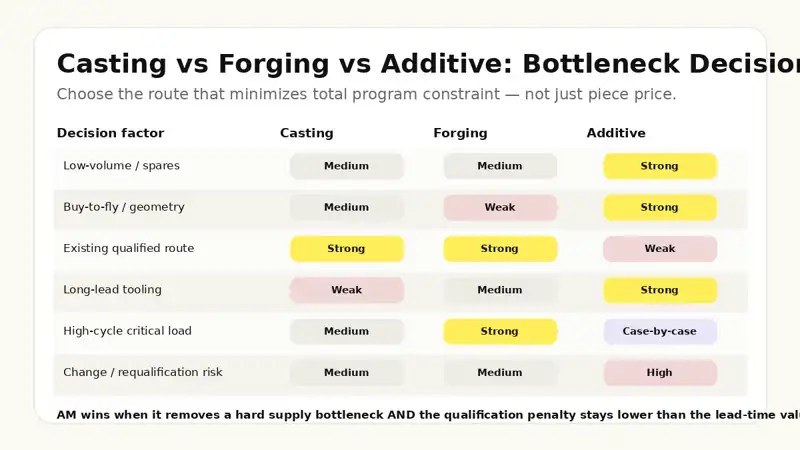
Casting vs forging vs additive: the decision matrix
| Part / program condition | Casting | Forging | Additive |
|---|---|---|---|
| High annual volume with stable geometry | Usually strong once tooling/process are established | Strong for load-critical shapes if capacity exists | Often weak on unit economics unless geometry creates major value |
| Low volume / spares / obsolescence | Tooling and MOQ can hurt | Small lots can be difficult | Often strong, especially with digital inventory |
| Very high structural load / fatigue criticality | Application-dependent | Often preferred due to mature property pedigree | Possible, but qualification and defect tolerance can dominate |
| Complex internal flow paths | Possible but tooling/core complexity rises | Usually poor fit | Strong technical fit; inspectability may become the gate |
| Extreme buy-to-fly ratio | Potentially good | Can still require heavy machining | Potentially strong for expensive Ti/Ni alloys |
| Long tooling lead time | Weak for urgent demand | Dies/tooling can constrain response | Strong if a qualified AM route already exists |
| Existing mature qualified supply chain | Strong | Strong | AM must overcome a qualification penalty to justify change |
| Supplier capacity crisis | May be the bottleneck | May be the bottleneck | Can be a resilience route if downstream AM capacity is actually available |
When AM genuinely removes the bottleneck
1. Low-volume, long-lead hardware
AM is strongest when tooling amortization is poor, demand is intermittent and carrying inventory is expensive. Legacy spares, defense sustainment hardware and space components often fit this pattern.
2. Titanium or nickel parts with punitive buy-to-fly
If the conventional route starts from a large billet or forging and machines most of it away, near-net AM can reduce raw-material exposure. That advantage is most valuable when alloy supply is constrained or scrap recovery does not fully compensate for long lead time.
3. Tooling is the pacing item
Investment-casting tooling, cores, forging dies and associated development loops can make the calendar inflexible. AM can collapse tooling time—but only if the AM process route is already mature enough to avoid replacing a tooling delay with a qualification delay.
4. Part consolidation removes supplier interfaces
A printed assembly that eliminates multiple details, welds, braze joints, fasteners or supplier handoffs may remove more schedule risk than its unit cost suggests. The value is system-level simplification.
When AM only transfers the bottleneck
- Powder/feedstock: a constrained or single-source alloy can recreate the same upstream dependency.
- HIP and heat treatment: downstream special-process capacity may become the new queue.
- Machining: AM rarely eliminates all machining for aerospace interfaces and critical surfaces.
- CT/NDT: complex internal geometry can require expensive inspection with limited throughput.
- Surface integrity: fatigue-critical parts may need substantial finishing and validation.
- Qualification: the biggest trap is switching to AM to save six months of sourcing and then spending 18 months proving the new route.
The qualification penalty
The correct economic model should treat qualification like an up-front switching cost. A legacy casting or forging route may have terrible lead time but decades of accepted data. AM may have excellent responsiveness but require new material/process evidence, inspection substantiation, machine equivalence work and component-level testing.
A simple decision rule is:
Choose AM when the present value of avoided lead time, inventory, tooling, scrap and supply risk is greater than the qualification penalty plus the new recurring AM constraints.
A five-case screen
| Case | Likely answer | Why |
|---|---|---|
| Low-volume Ti bracket, heavy machining from billet, non-fracture-critical | AM candidate | Material savings + no tooling + manageable evidence burden. |
| High-volume rotating engine disk | Forging remains favored | Extreme property/defect-tolerance requirements and mature forged pedigree. |
| Complex combustor or thermal-management feature | AM can win | Geometry creates functional value conventional processes struggle to achieve. |
| Legacy casting with broken tooling and 18-month supplier lead time | AM worth screening | Obsolescence and tooling avoidance can dominate if qualification scope is bounded. |
| Simple commodity geometry with stable qualified forging supply | Stay conventional | AM adds cost and qualification with little bottleneck value. |
The key procurement mistake
Teams often compare the quoted AM part price with the quoted casting/forging price. That misses the point. The comparison should include calendar time, tooling cash, inventory, material yield, minimum order quantities, supplier concentration, engineering-change responsiveness, post-processing queues, inspection throughput and qualification cost.
AM is not automatically cheaper. It can be economically superior because it changes the shape of the constraint.
Sources & further reading
- Deloitte — 2026 Aerospace & Defense Industry Outlook, midyear update
- GE Aerospace — acquisition of Consolidated Precision Products, September 2026
- BCG — Fixing Aerospace’s Supply Chain: Casting and Forging
- NIST — CM4QC
This decision framework is directional. Flight-critical manufacturing-route changes require application-specific engineering, quality and regulatory review.

