Tag: forging

  • Casting vs Forging vs Additive Manufacturing: When Does AM Actually Remove the Bottleneck?

    Casting vs Forging vs Additive Manufacturing: When Does AM Actually Remove the Bottleneck?

    Additive manufacturing does not remove every aerospace bottleneck. Sometimes it removes tooling and long-lead forgings; sometimes it simply moves the constraint into powder, HIP, machining, CT/NDT or qualification. The right comparison is total program constraint, not printer cycle time.
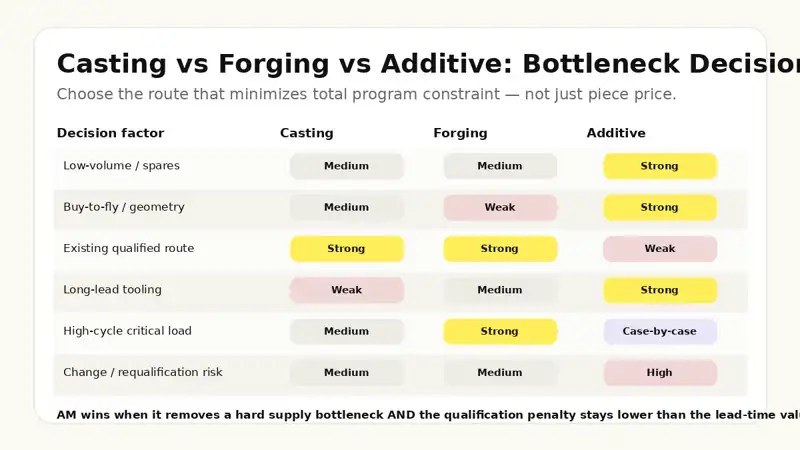
    Decision matrix comparing casting, forging and additive manufacturing across supply-chain and qualification factors.
    A practical decision map: AM is most valuable when it removes a hard supply bottleneck and the qualification penalty is smaller than the lead-time value created.

    Why this question matters in 2026

    Aerospace supply chains are still constrained by engines, electronics, castings, forgings, titanium and high-temperature alloys. Deloitte’s 2026 aerospace and defense outlook describes AM as a targeted resilience tool for low-volume, long-lead or hard-to-source parts—not as a universal replacement for conventional manufacturing.

    The constraint is visible in corporate actions, too. In September 2026, GE Aerospace announced an agreement to acquire Consolidated Precision Products, explicitly framing mission-critical casting capacity as necessary to support demand across commercial engines, aftermarket and defense. When an OEM is willing to spend billions to secure casting capacity, “just print it” is clearly not the default answer—but neither is “stay with the legacy route forever.”

    The bottleneck-removal test

    Before choosing AM, ask four questions in sequence:

    1. What is the actual constraint? Tooling? Raw material? Forge/foundry capacity? Buy-to-fly? Machining? Supplier minimum order quantity? Obsolescence?
    2. Can AM remove that constraint technically? Does the geometry, alloy, size and property requirement fit a mature process route?
    3. What new constraint does AM introduce? Powder/feedstock, build rate, support removal, HIP, heat treatment, machining, surface finish, CT/NDT, machine equivalence or qualification?
    4. Is the net program value positive? Compare avoided lead time and inventory against qualification, post-processing, yield and recurring cost.

    Casting vs forging vs additive: the decision matrix

    Part / program conditionCastingForgingAdditive
    High annual volume with stable geometryUsually strong once tooling/process are establishedStrong for load-critical shapes if capacity existsOften weak on unit economics unless geometry creates major value
    Low volume / spares / obsolescenceTooling and MOQ can hurtSmall lots can be difficultOften strong, especially with digital inventory
    Very high structural load / fatigue criticalityApplication-dependentOften preferred due to mature property pedigreePossible, but qualification and defect tolerance can dominate
    Complex internal flow pathsPossible but tooling/core complexity risesUsually poor fitStrong technical fit; inspectability may become the gate
    Extreme buy-to-fly ratioPotentially goodCan still require heavy machiningPotentially strong for expensive Ti/Ni alloys
    Long tooling lead timeWeak for urgent demandDies/tooling can constrain responseStrong if a qualified AM route already exists
    Existing mature qualified supply chainStrongStrongAM must overcome a qualification penalty to justify change
    Supplier capacity crisisMay be the bottleneckMay be the bottleneckCan be a resilience route if downstream AM capacity is actually available

    When AM genuinely removes the bottleneck

    1. Low-volume, long-lead hardware

    AM is strongest when tooling amortization is poor, demand is intermittent and carrying inventory is expensive. Legacy spares, defense sustainment hardware and space components often fit this pattern.

    2. Titanium or nickel parts with punitive buy-to-fly

    If the conventional route starts from a large billet or forging and machines most of it away, near-net AM can reduce raw-material exposure. That advantage is most valuable when alloy supply is constrained or scrap recovery does not fully compensate for long lead time.

    3. Tooling is the pacing item

    Investment-casting tooling, cores, forging dies and associated development loops can make the calendar inflexible. AM can collapse tooling time—but only if the AM process route is already mature enough to avoid replacing a tooling delay with a qualification delay.

    4. Part consolidation removes supplier interfaces

    A printed assembly that eliminates multiple details, welds, braze joints, fasteners or supplier handoffs may remove more schedule risk than its unit cost suggests. The value is system-level simplification.

    When AM only transfers the bottleneck

    • Powder/feedstock: a constrained or single-source alloy can recreate the same upstream dependency.
    • HIP and heat treatment: downstream special-process capacity may become the new queue.
    • Machining: AM rarely eliminates all machining for aerospace interfaces and critical surfaces.
    • CT/NDT: complex internal geometry can require expensive inspection with limited throughput.
    • Surface integrity: fatigue-critical parts may need substantial finishing and validation.
    • Qualification: the biggest trap is switching to AM to save six months of sourcing and then spending 18 months proving the new route.

    The qualification penalty

    The correct economic model should treat qualification like an up-front switching cost. A legacy casting or forging route may have terrible lead time but decades of accepted data. AM may have excellent responsiveness but require new material/process evidence, inspection substantiation, machine equivalence work and component-level testing.

    A simple decision rule is:

    Choose AM when the present value of avoided lead time, inventory, tooling, scrap and supply risk is greater than the qualification penalty plus the new recurring AM constraints.

    A five-case screen

    CaseLikely answerWhy
    Low-volume Ti bracket, heavy machining from billet, non-fracture-criticalAM candidateMaterial savings + no tooling + manageable evidence burden.
    High-volume rotating engine diskForging remains favoredExtreme property/defect-tolerance requirements and mature forged pedigree.
    Complex combustor or thermal-management featureAM can winGeometry creates functional value conventional processes struggle to achieve.
    Legacy casting with broken tooling and 18-month supplier lead timeAM worth screeningObsolescence and tooling avoidance can dominate if qualification scope is bounded.
    Simple commodity geometry with stable qualified forging supplyStay conventionalAM adds cost and qualification with little bottleneck value.

    The key procurement mistake

    Teams often compare the quoted AM part price with the quoted casting/forging price. That misses the point. The comparison should include calendar time, tooling cash, inventory, material yield, minimum order quantities, supplier concentration, engineering-change responsiveness, post-processing queues, inspection throughput and qualification cost.

    AM is not automatically cheaper. It can be economically superior because it changes the shape of the constraint.

    Sources & further reading

    This decision framework is directional. Flight-critical manufacturing-route changes require application-specific engineering, quality and regulatory review.

  • Metal Additive Manufacturing vs Casting vs Forging: How to Choose

    Metal Additive Manufacturing vs Casting vs Forging: How to Choose

    Metal additive manufacturing, casting and forging are not direct substitutes in every application. Each process creates a different combination of geometry, material condition, tooling, production rate, inspection burden and cost. The right choice depends on the complete product and manufacturing system.

    The most useful comparison is not “Which process is best?” It is “Which route delivers the required part performance, volume and lead time with the lowest total risk?”

    The processes in one sentence

    • Metal additive manufacturing: builds material layer by layer or deposit by deposit from powder or wire, usually with significant post-processing.
    • Casting: fills a mold with molten metal and solidifies the geometry inside the mold cavity.
    • Forging: shapes solid metal through controlled plastic deformation using presses, hammers or dies.

    Machining, heat treatment, joining, coating and inspection are commonly combined with all three. In many successful programs, the final answer is a hybrid route rather than a single process.

    Quick comparison

    CriterionMetal AMCastingForging
    Geometric complexityVery high for suitable processes; strong for internal channels and part consolidationHigh, especially with investment casting, cores and modern mold technologiesModerate; constrained by material flow, tooling and draft
    Tooling requirementLow hard-tooling requirement, but build files, fixtures and process development remain necessaryPattern, mold, core or die system required; tooling depends on casting typeDies and preform development often required for closed-die production
    Economic volumeTypically low-to-medium volume and high-value partsRanges from one-off sand castings to very high-volume die castingBest for medium-to-high volumes when tooling and development can be amortized
    Part sizeProcess dependent: LPBF favors smaller complex parts; DED/WAAM supports large near-net shapesVery broad, from precision investment castings to extremely large structuresBroad but constrained by press capacity, tooling and handling
    As-produced toleranceProcess dependent; critical interfaces often machinedProcess dependent; investment and die casting can be precise, sand casting less soNear-net shape; machining commonly required
    Surface finishOften rough as-built, especially down-facing or DED surfacesStrongly dependent on mold process and alloyGenerally better than large-bead AM but usually not final for precision interfaces
    Material efficiencyCan reduce buy-to-fly for expensive alloys; powder, supports and scrap still matterHigh shape efficiency, but gates, risers and rejected castings affect yieldGood yield with optimized preforms, although flash and machining stock remain
    Mechanical-property directionalityCan be significant and route-specificControlled by solidification, section size, heat treatment and defect populationGrain flow and deformation history can be aligned with loading
    Qualification maturityHigh for selected applications, but route-specific and data intensiveMature across many alloys and industriesMature for high-integrity structural hardware

    Geometry and design freedom

    Metal AM has a clear advantage when the product requires internal passages, lattice structures, topology optimization, local material placement or consolidation of many components into one. However, “complexity is free” is misleading. Complex AM geometry can increase build time, support burden, powder-removal difficulty, inspection complexity and qualification cost.

    Casting can also create complex geometry. Investment casting, ceramic cores, soluble cores and 3D-printed sand molds can produce internal features and thin sections at scale. Casting becomes especially competitive when the geometry is repeatable and tooling cost can be amortized.

    Forging offers less geometric freedom, but creates strong, efficient load-carrying shapes. Near-net and precision forging can reduce machining while preserving beneficial material flow. The design must respect die fill, draft, flash, parting-line and deformation constraints.

    Microstructure and mechanical properties

    There is no universal property ranking in which forging is always best, AM is always second and casting is always worst. Performance depends on alloy, defect population, heat treatment, geometry, orientation, surface condition, inspection and the specific property being measured.

    Metal AM

    Rapid, directional solidification can create fine microstructural features, texture, residual stress and orientation-dependent properties. Heat treatment and hot isostatic pressing can reduce some forms of porosity and modify microstructure, but they do not automatically remove surface defects, inclusions or every lack-of-fusion indication.

    AM parts can achieve excellent tensile and fatigue performance when the complete route is controlled. The relevant data must match the actual machine, material, parameters, orientation, post-processing and surface condition.

    Casting

    Cast microstructure depends on solidification rate, thermal gradient, mold material, section thickness, grain refinement and heat treatment. Castings can contain shrinkage, gas porosity, inclusions, hot tears or segregation, but mature foundry controls and appropriate inspection can produce high-integrity hardware.

    Investment-cast turbine components demonstrate that casting is not limited to low-performance applications. The process is often selected because it combines complex geometry, specialized alloys and production repeatability.

    Forging

    Forging refines and redirects the worked structure, closes some internal voids and can align grain flow with the component geometry. These features are valuable for fatigue, fracture and impact-sensitive applications. Forgings are not automatically defect-free; laps, folds, underfill, inclusions, segregation inherited from stock and heat-treatment issues still require control.

    Fatigue performance

    Fatigue is often controlled by the largest damaging discontinuity located in a highly stressed region. For metal AM, as-built roughness and near-surface defects can dominate. For castings, shrinkage or inclusions may control life. For forgings, surface condition, grain flow, residual stress and material cleanliness remain important.

    Comparisons should therefore use the same alloy condition, specimen geometry, surface finish, stress ratio, environment and statistical basis. Comparing polished AM coupons with as-cast components or handbook wrought data rarely supports a sound production decision.

    Tooling, lead time and design change

    AM avoids many forms of dedicated hard tooling, which can shorten the path to first hardware and make design changes less expensive. It still requires parameter development, build preparation, fixtures, supports, post-processing plans and qualification evidence.

    Casting lead time depends heavily on the tooling route. Printed sand molds and cores can remove pattern-tooling delays for prototypes and low volumes. Production investment casting and die casting require more development but can deliver strong unit economics at scale.

    Forging usually has the highest process-development and die commitment, particularly for closed-die components. Once established, it can provide high throughput and consistent high-integrity preforms.

    Production volume and total cost

    Unit cost should include more than the primary forming step. A complete model includes:

    • Material and material yield
    • Tooling, patterns, dies, fixtures and build plates
    • Machine, furnace and press time
    • Labor and engineering support
    • Heat treatment, HIP and stress relief
    • Support, gate, riser or flash removal
    • Machining and surface finishing
    • Inspection, testing and documentation
    • Scrap, rework and first-pass yield
    • Inventory, logistics and lead-time exposure

    AM is often competitive when the annual volume is low, the material is expensive, the conventional buy-to-fly ratio is high, the part consolidates assemblies or the performance gain has system value. Casting and forging generally gain advantage as stable volume rises and tooling is amortized.

    Inspection and quality risk

    Every process creates characteristic defect risks. The inspection plan should be selected from the credible failure modes and geometry rather than inherited without review.

    ProcessTypical concernsInspection challenge
    Metal AMLack of fusion, porosity, cracks, inclusions, distortion, rough surfaces and trapped powderComplex internal geometry and orientation-sensitive defects
    CastingShrinkage, gas porosity, inclusions, misruns, hot tears and dimensional variationSection thickness, complex geometry and defect distribution
    ForgingLaps, folds, underfill, bursts, flow-line issues and inherited material defectsComplex shape, grain flow and near-surface indications

    Process maturity does not eliminate inspection; it changes what evidence is available and how reliably the process can prevent or detect nonconformance.

    When metal AM is the strongest option

    • Complex internal channels or integrated functions create a clear performance benefit.
    • Annual volume is low enough that casting or forging tooling is difficult to justify.
    • The component consolidates multiple parts, welds, seals or assembly operations.
    • Conventional machining removes a large amount of expensive alloy.
    • Lead time, obsolete tooling or digital inventory has significant business value.
    • A qualified process, material and post-processing route exists.

    When casting is the strongest option

    • The part has repeatable complex geometry and meaningful production volume.
    • The alloy and foundry route are mature.
    • Tooling cost can be amortized across the program.
    • Large size or thin complex sections exceed practical AM economics.
    • Printed molds or cores can provide low-volume agility without changing the final cast material route.

    When forging is the strongest option

    • The component is highly loaded and benefits from controlled grain flow.
    • Production volume supports die and process-development investment.
    • The geometry can be created as a near-net preform and finish machined.
    • Long field experience and established material allowables are important.
    • Supply-chain capacity and qualified forging sources are available.

    Hybrid routes are often the best answer

    Several high-value strategies combine the strengths of the processes:

    • DED features added to a forged or machined substrate
    • WAAM preforms followed by five-axis machining
    • 3D-printed sand molds and cores used for conventional casting
    • LPBF inserts integrated into a larger fabricated or cast assembly
    • Forged load-bearing sections combined with AM fluid or thermal features

    These routes should be evaluated at system level. Joining, interface design, heat treatment, inspection and configuration control can become the new bottlenecks.

    A practical decision sequence

    1. Define loads, life, environment, critical surfaces and acceptable failure modes.
    2. Establish annual volume, program duration and lead-time requirements.
    3. Identify which geometric features actually create product value.
    4. Compare available alloy and qualification maturity for each route.
    5. Model complete cost through accepted finished part, not near-net shape.
    6. Review post-processing, machining and inspection access.
    7. Evaluate supply-chain capacity, tooling risk and change-control burden.
    8. Consider hybrid routes before forcing the design into one process family.

    Conclusion

    Metal AM wins when geometry, low volume, material savings or system performance justify its higher process-control and post-processing burden. Casting wins when complex repeatable shapes and scale matter. Forging wins when robust structural performance, grain flow and mature production economics dominate. The best manufacturing decision is requirement-driven, process-neutral and based on the complete route to an accepted part.

    Related Addithive resources: Metal AM Process Selection · Wire Arc Additive Manufacturing

    References and further reading

    Company research and reading path updated 12 September 2026.

    Which businesses are exposed to the process decision?

    BusinessConnectionInvestment question
    Howmet AerospaceEstablished aerospace components and engineered metal manufacturingCould qualified conventional capacity retain value even as selected parts migrate to AM?
    Nikon / Nikon SLMLPBF equipmentDoes a part redesign lead to recurring qualified production or only a machine trial?
    Carpenter TechnologySpecialty metal powdersDoes adoption generate repeat material demand with defensible qualification requirements?

    This is an analytical comparison of business exposure, not a claim that these companies compete for every part. Evaluate each supplier against the exact alloy, application and qualified route.

    Company exposure is a research starting point, not a stock recommendation. A relevant technology does not establish material revenue, attractive margins or a reasonable valuation. Check current filings, ownership, cash flow and customer concentration before drawing an investment conclusion.

    Compare large-part manufacturing routes and accepted-part cost.

    Take the next step: the free AM Bottleneck Atlas

    Assess AM, casting and forging through the full production route. The Industrial AM Bottleneck Atlas 2026 connects manufacturing constraints with qualification, economics and company exposure.

    Get the free Atlas and subscribe to the AM Bottleneck Brief →

    Confirm your email after subscribing. See the Atlas page for delivery details.

    CONTINUE THE INTELLIGENCE PATH

    From technical constraint to company exposure

    Map the bottleneck → · Find exposed companies → · See what changed →

    Continue the analysis

    Map the constraint: Interactive AM Bottleneck Graph

    Companies to inspect: Carpenter Technology · ATI · voestalpine

    Track changes: AM Company Signals · Company Database

    Get the AM Bottleneck Brief →