Additive manufacturing (AM) creates a physical part directly from digital data by adding material in successive layers or deposits. The familiar term 3D printing is often used interchangeably, but in industrial settings additive manufacturing usually refers to the complete production system: design, build preparation, printing, post-processing, inspection, qualification and configuration control.
The important question is not whether a part can be printed. It is whether the complete manufacturing route can deliver the required performance, cost, lead time and repeatability.
What additive manufacturing is — and what it is not
AM differs from subtractive processes such as machining, which remove material, and formative processes such as casting, forging or molding, which shape material using a tool or die. That distinction does not make AM automatically better. Most production parts still require a hybrid route that combines printing with heat treatment, support removal, machining, surface finishing and inspection.
AM is most valuable when it changes the economics or performance of a product. Typical value drivers include part consolidation, internal channels, lightweight structures, patient-specific geometry, rapid design iteration, digital inventory, low-volume production and repair of high-value components.

The seven main additive manufacturing process categories
ISO/ASTM terminology groups additive manufacturing into seven broad process categories. Commercial names vary by supplier, so the process category is usually the clearest starting point.
| Process category | How material is added | Typical materials | Common uses |
|---|---|---|---|
| Vat photopolymerization | Light selectively cures liquid photopolymer resin | Photopolymers, filled resins | Dental models, tooling, visual prototypes, hearing devices |
| Material extrusion | Material is dispensed through a nozzle | Thermoplastics, composites, bound metal or ceramic feedstocks | Prototypes, fixtures, low-cost end-use parts, large-format tooling |
| Powder bed fusion | Thermal energy selectively fuses regions of a powder bed | Polymers and metals | Aerospace hardware, medical implants, production polymer parts |
| Binder jetting | A liquid binder selectively joins powder; many metal routes require debinding and sintering | Sand, metals, ceramics | Casting molds and cores, sinter-based metal parts, ceramics |
| Material jetting | Droplets of build material are selectively deposited | Photopolymers, waxes, metals in specialized systems | Dental, investment-casting patterns, multi-material visual models |
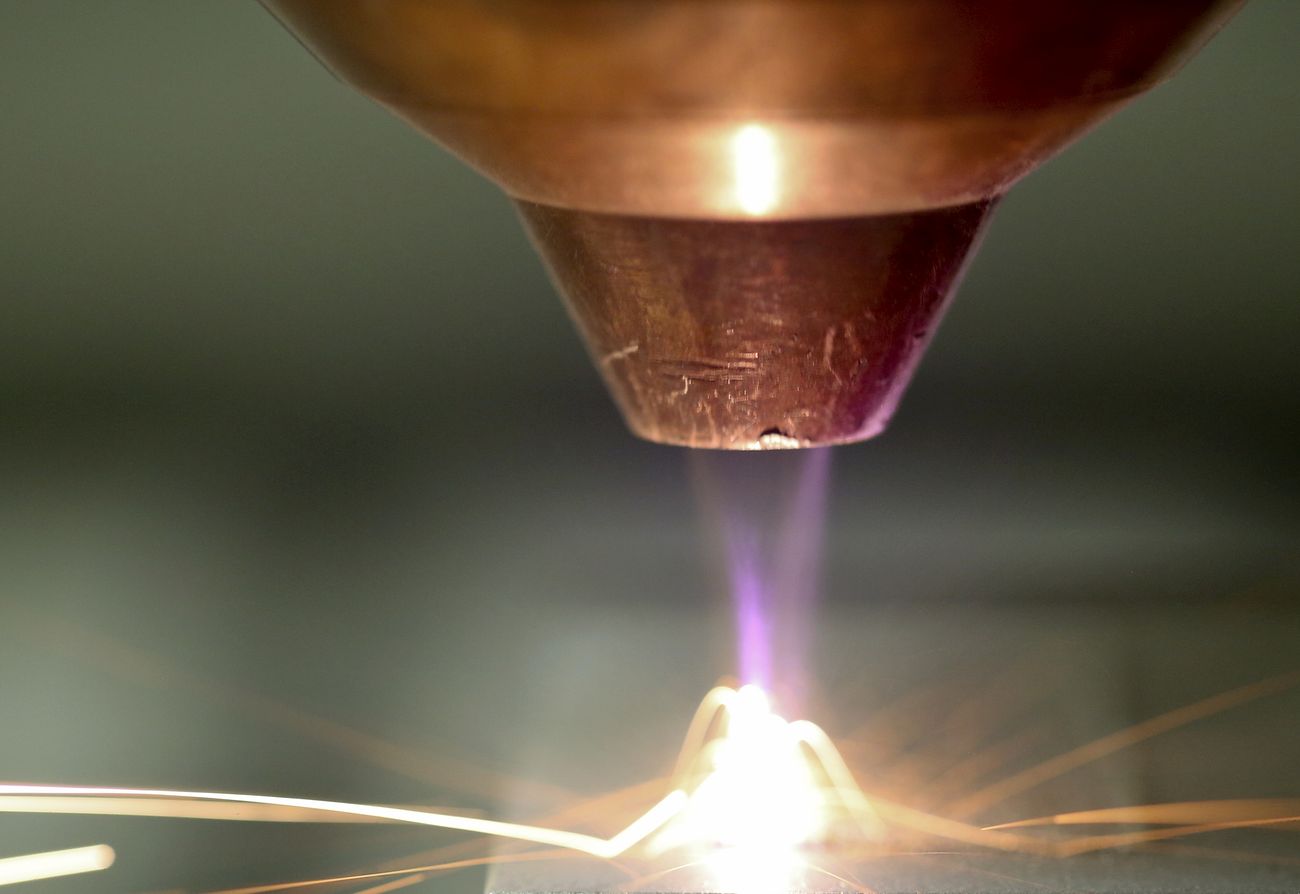
| Directed energy deposition | Focused energy melts feedstock as it is deposited | Metal powder or wire | Repair, feature addition, large near-net-shape components |
| Sheet lamination | Sheets are bonded and cut into shape | Paper, polymers, metals | Visual models, tooling and specialized metal laminates |
How the industrial AM workflow works
- Define the requirement. Start with loads, environment, life, tolerances, surface condition, regulatory requirements and production volume — not with a preferred printer.
- Select the process and material route. The machine, feedstock, process parameters and post-processing route form one manufacturing system. A material name alone does not define performance.
- Design for the process. Orientation, support strategy, minimum feature size, powder removal, machining allowance, inspection access and thermal behavior must be considered early.
- Prepare and build. The digital model is converted into layers or toolpaths. Build preparation includes nesting, orientation, support generation, parameter selection and traceability controls.
- Post-process. Depending on the route, this can include curing, depowdering, debinding, sintering, stress relief, hot isostatic pressing, support removal, machining and surface finishing.
- Inspect and validate. Dimensional inspection, material testing and nondestructive evaluation are selected according to the failure modes and acceptance requirements.
- Control the production system. Industrial AM requires qualified equipment, trained personnel, controlled feedstock, documented procedures and change management.
Where additive manufacturing creates the most value
- Complex, high-value parts: The economic case improves when geometry, performance or part consolidation matters more than raw deposition speed.
- Low-to-medium production volumes: AM avoids dedicated tooling and can shorten development cycles.
- High buy-to-fly or buy-to-use ratios: Near-net-shape production can reduce the amount of expensive material removed during machining.
- Customized products: Dental devices, implants, orthotics and specialized tooling benefit from digital variation without new hard tooling.
- Supply-chain resilience: Qualified digital inventory can reduce dependence on slow or obsolete tooling, although certification and data control remain significant barriers.
- Repair and feature addition: Directed energy deposition can restore high-value components or add local features to forged or machined substrates.
The limitations that matter in production
- Post-processing is often the real bottleneck. Printing may be only one step in a long production route.
- Material properties are process-route dependent. Orientation, machine condition, parameters, heat treatment and specimen location can change results.
- Surface finish and tolerances are not automatically production-ready. Critical interfaces frequently require machining or finishing.
- Qualification can dominate cost and schedule. Aerospace, medical and other safety-critical applications require evidence that the entire process is stable and repeatable.
- Build failures are expensive. Long build times, high-value powder and limited machine availability increase the cost of nonconformance.
- AM is not inherently sustainable. The environmental result depends on material yield, energy use, inert gas, post-processing, scrap, part life and the conventional route being displaced.
How to decide whether a part is a good AM candidate
A useful screening exercise asks five questions:
- Does AM enable a geometry or performance improvement that conventional manufacturing cannot deliver economically?
- Can multiple parts, welds or assembly operations be consolidated?
- Is the annual volume compatible with the expected build rate, post-processing capacity and cost per part?
- Is a qualified material and process route available for the required environment?
- Can powder removal, support removal, machining and inspection be completed without creating hidden risk?
If the answer is mostly no, conventional manufacturing or a hybrid route may be the better choice. A successful AM program begins with process-neutral engineering and a complete cost model.
Additive manufacturing in aerospace, medical and industrial production
Aerospace applications emphasize weight reduction, thermal performance, part consolidation and high-value low-volume production. Medical and dental applications benefit from patient-specific geometry, porous structures and digital workflows. Industrial users increasingly apply AM to tooling, spare parts, heat exchangers, fluid systems and repair. In each sector, the durable advantage comes from integrating design, material science, process control and qualification — not from the printer alone.
3D printing vs additive manufacturing: is there a difference?
The terms are built on the same fundamental idea: creating a three-dimensional object by adding material from digital data. In everyday use, 3D printing often describes desktop machines, prototyping and the printing step itself. Additive manufacturing is more common in industrial environments, where the term includes the complete controlled route from design and feedstock through post-processing, inspection and part release.
This is primarily a difference in context, not a boundary between two separate technologies. A desktop material-extrusion machine is an additive manufacturing system, and an industrial metal LPBF machine also performs 3D printing. For clear technical communication, name the process category and material rather than relying on either umbrella term alone.
| Context | Useful wording | Example |
|---|---|---|
| General public or hobby use | 3D printing | Desktop FFF printing in PLA |
| Industrial production | Additive manufacturing | Qualified LPBF production of a metal component |
| Technical specification | Standardized process category | PBF-LB/M, material extrusion or vat photopolymerization |
| Supplier-specific discussion | Process plus platform or commercial name | Polymer SLS on a defined machine and material system |
How a beginner should get started
The best starting point depends on whether the objective is learning, prototyping or industrial production. Do not begin by comparing printers. Begin with the part, material and result you need.
- Define the first project. Choose a small, useful object with simple success criteria. A fixture, enclosure, visual model or replacement knob teaches more than an overly ambitious demonstration part.
- Select the process by need. Desktop material extrusion is usually the most accessible route for durable prototypes and learning. Resin vat photopolymerization is attractive for fine detail but requires stricter chemical handling, washing and curing. Industrial metal and polymer systems normally require trained operators and controlled facilities.
- Choose a suitable material. Match temperature, strength, stiffness, chemical exposure, UV resistance and safety to the application. A printable material is not automatically suitable for service.
- Use or create a controlled model. Check dimensions, wall thicknesses, clearances, units and licensing. Repair mesh errors before slicing.
- Prepare the build. Orientation, supports, layer height, infill, temperatures and speed affect quality. Start with a validated profile and change one variable at a time.
- Print safely. Follow the equipment and material manufacturer’s ventilation, fire, electrical, powder, resin and personal-protection requirements. Do not treat all desktop materials as harmless.
- Inspect the result. Measure critical dimensions, examine layer bonding and test the part under realistic loads before using it in a functional or safety-relevant application.
- Record what worked. Save material lot, machine profile, orientation, settings and observed problems. Repeatability begins with a simple process record.
A basic desktop 3D-printing toolchain
| Step | Typical tool | What to learn first |
|---|---|---|
| Model creation | CAD, sculpting software or a licensed model repository | Dimensions, units, watertight geometry and design intent |
| Build preparation | Slicer supplied by or compatible with the printer | Orientation, supports, layer height, walls and material profile |
| Material handling | Dry storage for filament; controlled storage and PPE for resin | Moisture, contamination, shelf life and safe handling |
| Printing | Material-extrusion or resin printer | First-layer quality, calibration and monitoring |
| Post-processing | Support tools, washing/curing equipment or simple finishing tools | Safe removal, cleaning and dimensional preservation |
| Verification | Calipers, visual checks and application-specific testing | Fit, distortion, defects and functional limits |
For industrial adoption, the starting path is different: outsource representative parts, build DfAM and acceptance knowledge, identify a repeatable application pipeline, and only then decide whether internal equipment is justified.
Customization, efficiency and sustainability: the claims to test
Additive manufacturing can enable customization, reduce tooling and improve material utilization, but these benefits are not automatic.
- Customization: Digital variation can avoid new hard tooling, but design validation, data preparation and quality control still create cost. Customization creates value when the variation matters to the user or product performance.
- Efficiency: AM can shorten development cycles and consolidate assemblies. Printing may still be slower or more expensive than molding, casting, forging or machining at stable high volume.
- Material use: Near-net-shape production can reduce machining waste, especially for expensive alloys. Supports, powder refresh, failed builds, machining stock and post-processing losses must be included.
- Energy and emissions: Results depend on process energy, inert gas, furnaces, heat treatment, finishing, transport, product life and the conventional route being replaced. AM is not inherently low-carbon.
- On-demand production: Digital inventory can reduce physical stock, but only when the process, material, data, equipment and approvals remain available when the part is needed.
- New materials: AM can process specialized feedstocks and create unusual microstructures, but every new route requires material characterization, process control and application validation.
The correct comparison is a lifecycle and system-level assessment of the AM route against a defined alternative. Claims such as “zero waste,” “instant production” or “complexity is free” should be treated as marketing shortcuts rather than engineering conclusions.
Common beginner misconceptions
- A downloaded model is not necessarily printable, dimensionally correct or licensed for commercial use.
- Higher infill does not automatically create the strongest or most efficient part; walls, orientation, material and load direction matter.
- A visually successful print is not automatically safe for pressure, food contact, medical, electrical or load-bearing service.
- FDM/FFF, resin printing, polymer SLS and metal LPBF are different process systems with different materials, risks and design rules.
- Post-processing and inspection are part of the manufacturing process, not optional cleanup.
- Buying a more expensive machine does not replace application knowledge and process discipline.
Conclusion
Additive manufacturing is now a family of industrial processes rather than a single disruptive technology. Its strongest applications combine a clear product advantage with a realistic production route. Engineers should evaluate AM as a system: digital definition, feedstock, equipment, process parameters, post-processing, inspection and quality control all determine the final part.
Related Addithive resources: Metal AM Process Selection · Metal AM Supply Chain Map