Aerospace additive manufacturing can make a part quickly. Qualifying the material-process-machine-part system is usually the slower problem. The useful planning question is not “How fast can we print it?” but “How long until we have enough controlled evidence to release it for the intended application?”

The short answer: plan for an evidence program, not a print job
For a low-criticality application using a mature alloy/process combination, qualification burden can be modest. For a new flight-critical component, a new alloy, a new machine family, or a design with hard-to-inspect internal features, the evidence program can dominate the schedule and the budget.
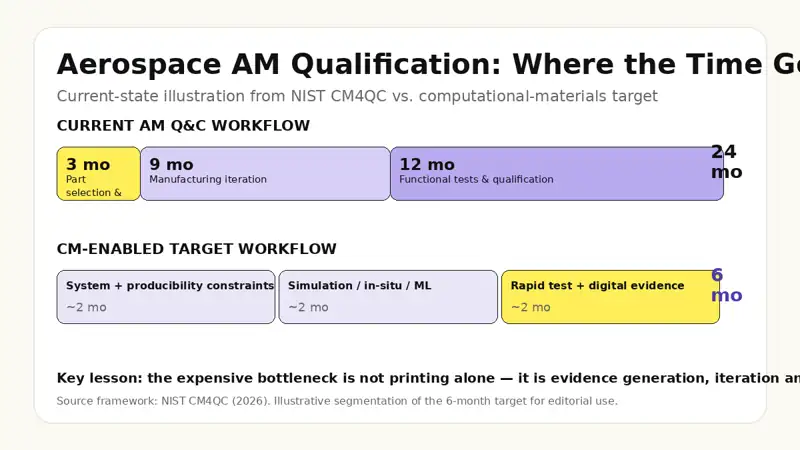
The 2026 Computational Materials for Qualification and Certification (CM4QC) program is unusually useful because it frames the bottleneck directly. NIST’s project page shows a representative current AM workflow of about 24 months: roughly 3 months for part selection/design, 9 months for manufacturing iteration and 12 months for functional tests and qualification. Its future-state vision compresses that to roughly 6 months by using simulation, in-situ data, machine learning, NDT and digital evidence more effectively.
The underlying NASA/FAA/NIST CM4QC strategy document, published in 2026, is explicit about the problem: traditional qualification and certification approaches can create high costs, long development timelines and repeated design/process iterations for process-intensive materials such as metal AM.
A practical aerospace AM qualification timeline
| Phase | What happens | Typical schedule risk |
|---|---|---|
| 1. Part & requirement definition | Criticality, loads, environment, life requirement, failure modes, acceptance criteria. | Requirements change after manufacturing work has already started. |
| 2. Material/process definition | Alloy, powder/feedstock controls, machine, parameter set, build layout, heat treatment, HIP, machining. | The process window is not stable or is too machine-specific. |
| 3. Build iteration | Coupons, witness specimens, distortion control, support strategy, defect reduction, repeatability. | Iterations multiply because design and process are coupled. |
| 4. Property & defect characterization | Microstructure, tensile, fatigue, fracture, creep as applicable; defect population and sensitivity. | Data scatter or defect mechanisms force another build campaign. |
| 5. Inspection & acceptance | NDT strategy, CT where needed, surface condition, dimensional inspection, acceptance limits. | Inspection capability cannot resolve the defect size/location that matters. |
| 6. Component substantiation | Functional, proof, durability, environmental or other application-specific tests. | Test failure exposes a design/process interaction not covered by coupons. |
| 7. Configuration & change control | Freeze the qualified envelope and define how changes are assessed. | A “small” machine, parameter, supplier or post-process change triggers new evidence. |
Where the money actually goes
Public sources rarely give a clean component-level qualification price because programs differ radically and most detailed cost data are proprietary. But the cost structure is predictable. NIST notes that empirical material qualification can require thousands of tests, cost millions of dollars and take years when a full statistical approach is required. For a specific aerospace AM component, the relevant question is how much of that evidence already exists and can legitimately be reused.
- Build campaigns: machine time, feedstock, witness coupons, failed builds and design/process iterations.
- Post-processing: heat treatment, HIP, machining, surface finishing and special processes.
- Characterization: metallography, chemistry, density/porosity, residual stress and dimensional work.
- Mechanical testing: the cost jumps when fatigue, fracture, creep or environment-specific testing is needed.
- NDT/CT: complex internal geometries may make inspection one of the pacing items.
- Engineering & documentation: statistical analysis, process control plans, material/process specifications, configuration management and the qualification package itself.
- Rework and requalification: the most expensive dollar is often the one spent after the team discovers that a requirement, process variable or inspection limit was never frozen.
The evidence map: what must connect to what?
A useful qualification package is not a pile of test reports. It is a connected argument that links manufacturing inputs to material state, defect state, part performance and acceptance controls.
| Evidence layer | Question it must answer | Examples |
|---|---|---|
| Feedstock | Is the input material controlled and traceable? | Chemistry, PSD, morphology, reuse limits, contamination controls. |
| Machine & process | Can the defined process repeatedly create the intended material state? | Machine calibration, parameter envelope, monitoring, build records. |
| Material state | What properties and variability result? | Microstructure, tensile, fatigue/fracture/creep as relevant. |
| Defect state | What defects exist, and how do they affect performance? | Porosity, lack of fusion, inclusions, surface-connected defects. |
| Inspection | Can production inspection detect what the design assumes it can detect? | CT/NDT capability, POD, dimensional inspection, surface inspection. |
| Component | Does the real part behave as the models/coupons predict? | Proof, functional, durability and environmental testing. |
| Production control | How will every future part stay inside the qualified envelope? | Acceptance criteria, SPC, witness strategy, change control. |
Where programs most often get stuck
1. The design moves faster than the qualification basis
AM encourages rapid geometry iteration. Qualification rewards configuration stability. If teams keep optimizing after test articles are produced, the evidence package can become disconnected from the final released configuration.
2. Machine equivalence is assumed instead of demonstrated
“Same model of machine” does not automatically mean “same qualified output.” Laser condition, recoater behavior, gas flow, calibration, software state and maintenance history can matter. A scaling plan needs an explicit equivalence strategy.
3. Inspection is treated as a downstream activity
Internal channels and topology-optimized structures may be manufacturable but difficult to inspect. If the required defect tolerance is below the practical capability of the selected NDT method, the problem is architectural, not just procedural.
4. The post-process becomes the real process
Heat treatment, HIP, machining and surface finishing can control final properties as much as the build itself. Qualification plans that focus narrowly on the printer often discover the real release gate later.
How to reduce qualification effort without lowering the bar
- Reuse evidence deliberately. Start from an alloy/process/machine/post-process combination with credible prior data when possible.
- Freeze the evidence architecture early. Define which claim is supported by simulation, coupon data, NDT, process monitoring and component testing.
- Design for inspectability. Treat NDT capability as a design input.
- Separate development variables from production variables. Experimental freedom is useful early; qualification needs a controlled envelope.
- Plan machine and supplier scaling before the first qualification build. Otherwise capacity expansion can trigger a second evidence campaign.
- Use computational methods where they reduce—not hide—uncertainty. That is the core direction of CM4QC: mature computational-materials methods so they can support qualification arguments and reduce unnecessary empirical burden.
A planning rule
The qualification burden rises when novelty, criticality, hidden geometry and configuration variability rise at the same time.
That is why two parts made from the same alloy on the same AM process can have completely different qualification economics. One may be a straightforward substitution. The other may be a new material-process-design-inspection system that needs its own evidence architecture.
Sources & further reading
- NIST — Computational Materials for Qualification and Certification (CM4QC)
- NASA Technical Reports Server — CM4QC Strategy Document (2026)
- NIST — Qualification for Additive Manufacturing Materials, Processes, and Parts
- NIST — CM4QC Phase II
Editorial note: time and cost ranges in aerospace qualification depend on application, authority, criticality, prior evidence, process maturity and organization-specific certification basis. This article is a planning framework, not regulatory guidance.

