Category: Uncategorized

  • Unleashing the Power of Additive Manufacturing with Artificial Intelligence: The Game-Changing Revolution You Can’t Afford to Miss!

    Unleashing the Power of Additive Manufacturing with Artificial Intelligence: The Game-Changing Revolution You Can’t Afford to Miss!

    Are you ready to witness the future of manufacturing? Additive manufacturing and artificial intelligence are two rapidly growing technologies that are transforming the way we make things. And when combined, they have the potential to revolutionize manufacturing and beyond.

    Additive manufacturing, also known as 3D printing, is the only manufacturing technology that can be fully digitalized. It involves creating objects layer-by-layer from a digital model, using a range of materials such as plastics, metals, and even living tissue. Meanwhile, artificial intelligence (AI) is enabling machines to learn, adapt, and make decisions like humans.

    The possibilities of combining these two technologies are endless. Anything that seemed impossible before, such as creating complex geometries, personalized medical devices, or self-assembling structures, can now be possible with the power of additive manufacturing and AI.

    In this blog post, we will explore the intersection of additive manufacturing and artificial intelligence and discuss how their combination can lead to revolutionary advancements in manufacturing and beyond. We will delve into the role of AI in additive manufacturing, the potential of AI-powered 3D printing, and the challenges and opportunities of integrating these technologies. Get ready to witness the future of manufacturing and join us on this exciting journey.

    The Role of AI in Additive Manufacturing

    Additive manufacturing involves a complex process of designing, printing, and post-processing. AI can optimize each of these steps to improve efficiency and accuracy. In the design process, AI can analyze data from previous designs to generate new ones that are optimized for strength, weight, and other factors. In the printing process, AI can monitor the printing process in real-time to detect and correct errors. This can reduce waste and improve the quality of the final product. Finally, AI can improve the entire additive manufacturing software toolchain, from design to post-processing, to create a seamless and efficient workflow.

    The benefits of using AI in additive manufacturing are numerous. By optimizing the design and printing process, we can reduce waste, improve quality, and increase speed. This can lead to significant cost savings and improved competitiveness for businesses. Additionally, AI can help us discover new design possibilities and optimize our products for specific use cases.

    The Future of Additive Manufacturing with AI

    The potential of AI-powered 3D printing and additive manufacturing is limitless. In the aerospace industry, for example, AI can be used to optimize the design of components for weight reduction and improve fuel efficiency. In the automotive industry, AI can be used to design and produce custom parts on-demand, reducing the need for large inventories. In healthcare, AI can be used to create personalized medical devices and implants that are optimized for each patient’s unique anatomy.

    The impact of AI and additive manufacturing on the supply chain is also significant. By allowing for on-demand production of parts, businesses can reduce their inventory and supply chain costs. Additionally, AI can optimize the production process to reduce lead times and improve overall efficiency.

    The Challenges of Combining Additive Manufacturing and AI

    Integrating AI and additive manufacturing can be complex, especially in highly regulated industries like healthcare and aerospace. Ensuring compliance with regulations and safety standards is crucial, and R&D and implementation can be expensive and time-consuming. Additionally, there may be limitations to the types of materials that can be used in additive manufacturing with AI, which can limit the range of applications.

    However, there are solutions to these challenges. Collaboration between companies and researchers can help to share knowledge and resources, reducing costs and speeding up the development process. Additionally, advancements in material science are expanding the range of materials that can be used in additive manufacturing, opening up new possibilities for innovation.

    Success Stories and Case Studies

    Real-world examples of companies and researchers using AI and additive manufacturing to innovate and create are abundant. Let’s take a closer look at some of the most exciting success stories and the lessons learned from each.

    • Gas Turbine and Power Generation companies will been using additive manufacturing and AI to optimize the design of gas turbine blades. By simulating different designs and materials, they will be able to create a blade with better aerodynamics and cooling performance. This resulted in higher efficiency and longer lifespan of the turbine.AI and additive manufacturing can lead to better product performance and longevity in the energy sector.
    • Aviation companies will been using additive manufacturing and AI to improve the production process of aircraft parts. By using machine learning algorithms to analyze sensor data from the 3D printers, they will be able to detect and prevent defects in real-time, reducing the amount of waste and improving the quality of the final product.AI and additive manufacturing can lead to better quality control and waste reduction in the aviation industry.
    • 3D printing machine makers will be using AI to improve the printing process and optimize material properties. By analyzing data on the printing process and the behavior of different materials, they will be able to create a software tool that can predict the properties of a printed part before it is printed. This allows for better design optimization and material selection.AI can help optimize the printing process and improve the quality of the final product in additive manufacturing.
    1. Medical Device and Implant companies will be using AI and additive manufacturing to create personalized medical implants. By analyzing data on the patient’s anatomy and bone density, they will able to create a customized implant that fits perfectly and promotes bone growth. This solution is faster, more accurate, and more affordable than traditional implant manufacturing methods. AI and additive manufacturing can lead to personalized medical solutions that are more accessible and affordable to patients.
    1. Automotive companies will been using AI and additive manufacturing to create complex jigs and fixtures for their production line. By using generative design algorithms and 3D printing, they will be able to create customized and lightweight fixtures that are more efficient and cost-effective than traditional methods.AI and additive manufacturing can lead to better tooling solutions that improve efficiency and cost-effectiveness in the manufacturing process.

    These examples demonstrate the diverse range of applications for AI and additive manufacturing. By leveraging data and machine learning, we can create innovative solutions that improve efficiency, sustainability, and cost-effectiveness across a range of industries. The possibilities are endless, and we can’t wait to see what the future holds for this exciting intersection of technologies.

    At Addithive, we believe that the future of manufacturing and innovation lies in the combination of additive manufacturing and artificial intelligence. We encourage businesses and researchers to embrace these technologies and explore the exciting possibilities they offer. The combination of additive manufacturing and AI has the potential to revolutionize manufacturing and beyond. By leveraging data and machine learning, we can optimize the design, printing, and post-processing of parts, improve quality control and waste reduction, create personalized medical solutions, and improve tooling and fixtures for the manufacturing process.

    The benefits of these technologies are clear, and it’s time for businesses and researchers to embrace them fully. By investing in research and development, and implementing AI and additive manufacturing solutions, companies can stay ahead of the curve and gain a competitive advantage.
  • Additive Manufacturing: The Future of Customization, Efficiency, and Sustainability

    Additive Manufacturing: The Future of Customization, Efficiency, and Sustainability

    Additive manufacturing, also known as 3D printing, has been rapidly gaining popularity in recent years. With its ability to create highly customized products quickly and efficiently, it has been hailed as the future of manufacturing. Here are five reasons why additive manufacturing is set to revolutionize the industry:

    Customization

    Additive manufacturing offers unparalleled customization options compared to traditional manufacturing methods. With the use of 3D modeling software, designers can create complex and intricate designs, with the printer capable of producing these designs in a matter of hours. However, with customization comes the risk of over-engineering or overspending on features that the customer may not want or need. To mitigate this risk, manufacturers can use data-driven insights to guide their design decisions, seeking feedback from customers at every stage of the product development process.

    Reduced Waste

    Additive manufacturing is known for producing significantly less waste than traditional manufacturing methods. As the printer only produces the exact amount of material needed to create the product, there is no excess material to dispose of. However, the use of plastic-based materials in 3D printing can also result in environmental risks. To mitigate this risk, manufacturers can use alternative materials, such as biodegradable or recycled materials, to reduce their carbon footprint.

    Faster Prototyping

    Additive manufacturing enables companies to prototype and iterate designs faster than traditional manufacturing methods. With 3D printing, manufacturers can produce and test multiple design iterations in a matter of days, allowing for more agile product development. However, there is a risk of over-prototyping or spending too much time on design iterations, delaying the product development process. To mitigate this risk, manufacturers should establish clear goals and timelines for each stage of the product development process.

    Sustainability

    Additive manufacturing offers significant sustainability benefits compared to traditional manufacturing methods. By producing parts on demand and only creating the exact number needed, it minimizes waste and reduces the carbon footprint of the manufacturing process. However, there is a risk of supply chain disruption or the availability of raw materials. To mitigate this risk, manufacturers can develop strategic partnerships with suppliers to ensure the availability of materials and reduce supply chain risks.

    New Materials

    Additive manufacturing enables the use of new materials that were previously difficult or impossible to work with. For example, 3D printing allows for the creation of complex geometries and shapes that traditional manufacturing methods cannot achieve. However, the use of new materials can also result in material defects or failures. To mitigate this risk, manufacturers should test and validate new materials before using them in production, ensuring that they meet the required performance standards.

    In conclusion, additive manufacturing is set to revolutionize the manufacturing industry by offering customized, efficient, and sustainable solutions. However, as with any technology, there are also risks associated with its use. Manufacturers must be aware of these risks and take appropriate measures to mitigate them. With its many benefits, additive manufacturing is undoubtedly the future of manufacturing.

  • Additive Manufacturing for The New Space Age

    Additive Manufacturing for The New Space Age

    The space industry is a great field for new technology development. The challenges such as lightweight and stronger components with the demand for higher trust and lighter rockets that can reach mars propel the demand for more advanced components. Emerging technologies are almost always initiated in space or defense industries because the demand for the better originates in these industries either by war or competition in the industry. Additive Manufacturing is also incepted in the aerospace industry and there are several great examples Large rockets, aircraft engines, satellites are all requires lighter and stronger parts. and the good thing is that the production volume for industrialization of these components way lower than the automotive industry. This makes these platforms a disruptive opportunity.

    Additive manufacturing provides faster cycle time and leaner production of testing components for a space platform program. This both the design cycle of the components and the overall schedule of the development programs. Another advantage of additive manufacturing for space components is the reduction of complexity. Additive manufacturing enables the complexity of the component while reducing the complexity of the overall realization of the component. Combining several sub-parts into a combined assembly that can be built by additive manufacturing. We will go over some of the recent advancements that are developed by different NASA research centers. We will go over Rocket engine component examples that are developed with additive manufacturing technology such as injectors, turbopumps, combustion chamber and more. These advancements are great examples and paves the way to new space age for reaching Mars and beyond.

    Rocket Engine Injectors

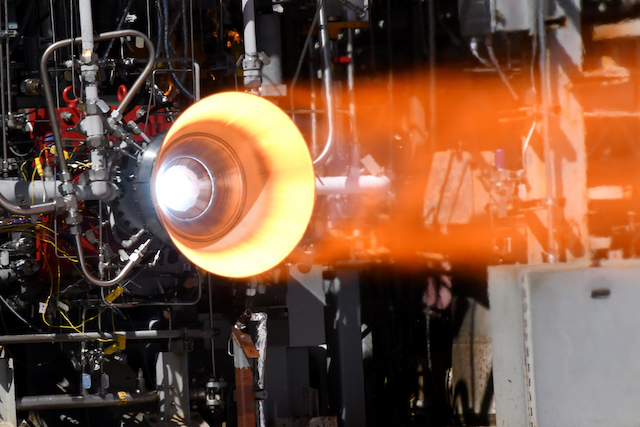
    Rocket Engine fuel injectors are simple but one of the most critical of a rocket engine because it defines the theoretical performance of the rocket nozzle. A well-designed injector enables efficient burning of the propellant. In addition to that, injectors help to reduce the thermal loads on the nozzle by cooling the internal nozzle surface with fuel. Injectors can be made by drilling small holes with a designed pattern that fuel and oxidizers travel. The holes break the fuel into small droplets, smaller the droplets burned easily and the efficiency of the combustion increased. The holes are can be drilled in conventional ways but it is costly when compared to additive manufacturing. Rocket engine injector successfully tested at NASA Glenn research center Rocket combustion lab with a benefit of lead time from 1 year to 4 months and 70% less cost. The main cost out opportunity is to reduce the number of parts. The additive injector has 2 parts, while its conventional version has 115 parts. This is a disruptive reduction for both cost, program execution, and simplification of the supply chain.

    NASA/MSFC

    Rocket Engine Turbopumps 

    Rocket Engine Turbopumps produce high-pressure propellant to feed rocket engine combustion chamber. These pumps are designed with turbo-machinery principles and the design of these components is as hard as a jet engine yet a well-designed turbopump can deliver 70–90% efficiency. This particular turbopump makes 90000 revolutions per minute (RPM) to pump propellant. NASA has developed a turbopump in 2015 for liquid hydrogen, which is an ideal propellant for space missions but it is pumped at -240 Celcius. Rocket engine turbopump has 45% fewer parts. Combining several parts into one complex additive part dramatically reduces both costs and the weight of the component. On top of that reducing the number of parts simplifies the supply and realization of the hardware.

    This rocket engine fuel pump has hundreds of parts including a turbine that spins at over 90,000 rpms
    NASA/MSFC

    Gimbal Cone

    There are many methods to change the exhaust direction of the rockets. One of the methods is to use a gimbal system. A gimbaled nozzle tilts the engine nozzle in the proper direction. Below Gimbal cone made of titanium at ORNL, The process used for this component is Electron Beam Melting. When compared to investing casting or other conventional manufacturing methods. The manufacture of titanium components like this gimbal has a great potential to reduce costs as well as lead time and overall weight of the component. Titanium alloys are expensive yet they provide lightweight and strong components. Especially Ti-6Al-4V is a great alloy for rockets, jet engines, and satellites. Of Course, there are challenges like material properties and how are these are changing with the variation of process features. Powder Process microstructure relations are complex and need to be investigated.

    NASA

    Rocket Engine Combustion Chamber 

    Rocket fuel and oxidizer flow in to combustion chamber with the help of turbo pump since the pressure inside the combustion chamber is extremely high. The combustion chamber mixes oxidizer and the fuel. The temperatures inside of the combustion chambers is over 2750 Celcius. This is far more than the melting temperature of copper alloy. In order to protect the chamber from melting during this extreme operation, It is being cooled by the extremely low temperature (-173 Celcius ) gas circulation inside the 200 tiny channels. These channels can only be manufactured by additive technology. It takes more than 10 days to build this rocket component but it is way faster than to manufacture it with conventional ways. Copper is a good heat conducter and this makes it a great match for this application. However, it makes it hard to melt with a laser scan. Overcoming these obstacles is not easy but enables game change rocket engines.

    NASA/MSFC/Emmett Given

    Structural Jacket using EB FFF (Free Form Fabrication)

    Copper combustor liners are good for thermal conductivity but they are not very strong. In order to solve this problem, it is covered with an IN625 (Nickel Alloy) structural jacket. Electron Beam Free Form Fabrication is a directed energy deposition technology. In this technique Electron Beam is used as energy source and it is directed to melt metal wires which are IN625 for this application. It is a very fast process that is developed by Sciaky Inc to deliver 5kg/hour. EB FFF technology derived from Electron Beam welding process which has been used in aerospace industry more than 50 years. One of the challenges of this process it works under vacuum since electron beam can only be generated by vacuum.

    NASA/MSFC/David Olive

    Rapid Analysis and Manufacturing Propulsion Technology (RAMPT) :

    NASA is working on Rapid Analysis and Manufacturing Propulsion Technology (RAMPT) to advance novel design and manufacturing technologies while increase scale, reduce cost, and improve performance of rocket engine components. Key focus areas of the program as below :

    1. Directed Energy Deposition (DED) focusing on blown powder techniques to enable integrated cooled channel wall nozzle.
    2. Multi material additive manufacturing modalities such as bimetallic and multi-metallic deposition techniques focusing on copper and nickel based super alloys.
    3. Engineering and simulation tools to predict and compensate material feed techniques distortion and material properties
    4. Last but not least development of design tools to get full benefit of additive enables design which primarily focuses on integrated cooled combustion chamber and nozzle
    NASA

    Conclusion

    Additive manufacturing is a great tool to reduce weight and cost while improving perfomance. This is exact need for the space technology and next generation rocket engines. Several different additive modalities under investigatin by NASA and these will be utilized on space programs. we observe and extensive use of additive manufacturing technology on space propulsion componentst. There are still problems and issues to advance the technology such as certification of components and development new alloys suitable for additive manufacturing. However these issues are also good opportunities for additive manufacturing industry partners, universities and material producers.

    References :

    Additive Manufacturing of Aerospace Propulsion Components -Dr. Ajay Misra, Dr. Joe Grady and Robert Carter – NASA Glenn Research Center Cleveland, OH – Doc: 20150023067 – https://ntrs.nasa.gov/citations/20150023067

    Lightweight Thrust Chamber Assemblies using Multi- Alloy Additive Manufacturing and Composite Overwrap – Paul R. Gradl , Chris Protz   John Fikes, Allison Clark NASA Marshall Space Flight Center, Huntsville, AL Laura Evans , Sandi Miller6, David Ellis NASA Glenn Research Center, Cleveland, OH Tyler Hudson NASA Langley Research Center, Hampton, VA

  • Additive Manufacturing: An opportunity in a VUCA World

    Additive Manufacturing: An opportunity in a VUCA World

    In the future, we will remember 2020 as a good example or even the start of a Volatile, Uncertain, Complex, and Ambiguous world. VUCA is a term generally used by the military to define war situations. As most of the leadership traits taken from the military, VUCA is also coming from the military. Military trains soldiers for the worst-case scenario where people fight and suffer. Parallel with that best leadership skills and concepts that are leveraged to the business world comes from the military. It has been started to be used in post-cold world era. Globalization and global networks and a more connected world now show us what it really means. 2020 feels like the definition of what is VUCA. If you want to put this term into a dictionary, put it like that:

    VUCA : World in 2020

    World Health Organization is notified on COVID-19 on January 7, and the global economy comes to a risk of recession in 5 months. Travel, Aviation, and Retail industries are the ones that are heavily impacted. Think about the supply chain supporting all of the products and services in these industries. Suppliers in these complex networks are shrinking and going out of business right now.

    Shutting down economies and slowing down global trade disrupted supply chains dramatically. With the reduced demand rate in especially in aviation industry tier 1–2 suppliers started to shrink down their operations. Suppliers are very similar to muscles in the human body. When the economy shrinks like when you stop eating, your muscles shrink first. This is what happens to suppliers right know. They are shrinking and going out of business. As all bodybuilders know well enough, it is tough to rebuild these muscles. A supplier may have a history of 10–20 years, and it can go out of business in a crisis like this in 3–6 months or big suppliers can downsize their operations and shut down their not all but some of the shops. Recovering these muscles is not easy. It is not possible to gain back in 3–6 months what you have built-in 10–20 years.

    OECD data shows that 70% of global trade depends on global supply chains. This is where the global economy drives its power. On the other hand, this network business is so connected and involved that its prone to the butterfly effect. Sometimes weakness may be the result of strength. Viruses like COVID-19 spread much faster in a globally connected network of people.

    Is COVID-19 a Black Swan or an event gets us prepared to the new normal. VUCA is becoming the new normal. This is not only a case for COVID-19. There would be other global changes that have a considerable risk of disrupting the global supply chain by looking at the news from the first month of 2020

    • January 2: Bushfires in Australia
    • January 2:Iranian General Soleimani killed in a US drone strike.
    • January 7: The WHO is notified new coronavirus
    • January 8: Iran launched ballistic missiles to bases in Iraq.
    • January 15: Trump Impeachment Inquiry
    • January 22:Locust outbreak in Kenya
    • January 31: UK Exists EU.

    This was just the first month of 2020 in the 2019 global economy impacted by trade wars. Original equipment manufacturers cannot respond to these changes and quickly adapts to the new normal with a conventional supply chain. There will be disruptions in the global supply chain more than ever because of global, economic, geopolitical, and technological abrupt changes, natural disasters, or competitive strategies.

    Thanks Morpheus

    Additive manufacturing, aka 3D printing, can help to balance the impact of global disruptions like COVID-19. How? Why?

    Additive manufacturing is a new tech that enables manufacturing of parts, even assemblies layer by layer from a computer file by consumable materials. The primary advantage of this technology is flexibility and complexity when compared to conventional methods.

    Oak Ridge National Laboratory

    You can check the above photo from ORNL (Oak Ridge National Laboratory) to understand what are the possibilities with additive manufacturing. The best thing is you do not need tooling for the manufacturing of different components. In conventional manufacturing, there is a set of tooling to enable the manufacturing of the components. For casting, a model and core needed to form casting mold for machining, a holder, and fixtures required for manufacturing. The worst thing is when you need to design the fixtures, tools, and molds before you can manufacture your actual part. It takes time to complete all of the tools and fixtures, and this is why conventional manufacturing is not as agile and flexible as additive manufacturing since there is no need of tools and fixtures for additive manufacturing, it is much easier to build several different parts and products with a single machine without the need of complex tooling.

    A conventional manufacturing shop has engineers technicians to support all of the efforts related to design, manufacture, and maintenance of tooling manufacturing and actual part manufacturing. In additive manufacturing shops, an operator can easily run 4–5 Additive manufacturing machines. An engineer can prepare part files that are needed for these machines. The good thing is when you have a part file that is capable of delivering the requirements of the part/product. The only need is to store this file and consumables. There is no need to store fixtures, tools, or there is no need to hold an inventory. It is possible to manufacturing when there is demand. It is possible to manufacture other parts when there is no demand for the work in hand. An additive manufacturing shop can be a medical device factory, a rocket part factory and automobile part factory at the same time or shift between industries with very little disruptions.

    Think about what we are going through right now. COVID-19 heavily disturbing century-old industries. A manufacturing supplier working in the aviation industry cannot survive this crisis. On the other hand, an additive manufacturing supplier can simply shift to the manufacturing of respirator parts for medical device OEMs instead of Aviation OEMs. It is also possible to continue to manufacture aviation components when the industry recovers from COVID-19 travel restrictions…

    Charles Darwin

    Think about a world that is not possible to plan for the next 6 months. Your production volume may change because of many reasons that are not in your control. An additive manufacturing shop is at least 10 times more flexible than a conventional manufacturing shop. Business with Vision to tackle challenges, Understanding to see the opportunities and Courage to take action and Adapt, it will thrive in a Volatile, Uncertain, Complex, and Ambiguous world.

    Vision, Understanding, Courage, and Adaptability are remedies to the VUCA world, while additive manufacturing is a remedy to the supply chain in a VUCA world.