The jewelry industry has always been at the forefront of innovation, incorporating new materials and techniques to create stunning pieces of wearable art. In recent years, 3D printing technology has become an increasingly important tool in the world of jewelry design and manufacturing. The ability to create intricate, customizable, and cost-effective designs has opened up a realm of possibilities for both established brands and independent designers alike.
In this blog post, we will delve into the fascinating world of 3D printed jewelry, exploring its rich history, current trends, and the exciting opportunities it presents for the future. By understanding the evolution of 3D printing in the jewelry industry, as well as the hardware and materials used, designers and manufacturers can make informed decisions about how to best integrate this technology into their own businesses. So, let’s begin our journey into the captivating world of 3D printed jewelry and uncover the potential it holds for revolutionizing the industry.

3D Printing Jewelry Market: A Brief History, Current Trends, and Future Prospects
The use of 3D printing in jewelry can be traced back to the 1990s when it was initially employed for creating investment casting patterns. This early application allowed for the production of intricate designs that were difficult to achieve using traditional wax carving techniques. As the technology evolved, 3D printing was also used to support vulcanized mold production, enabling the creation of more complex and accurate molds. The advent of directly-printed jewelry further expanded the possibilities for designers, allowing them to bring their intricate visions to life with unparalleled precision.
Today, 3D printing has found its way into various aspects of the jewelry industry, including the production of rings, earrings, pins, cufflinks, and other small accessories. It has also been utilized in the creation of timepieces, watches, and even “smart” accessories and wearable technologies. The rise of the “metaverse” has seen 3D printed jewelry make its way into the digital realm, while the growing popularity of non-fungible tokens (NFTs) has given rise to virtual jewelry pieces with real-world value. The COVID-19 pandemic has also had an impact on labor availability and material costs, further highlighting the advantages of 3D printing as a more efficient and cost-effective production method.
The jewelry industry has faced several challenges, including consolidation and the rise of e-commerce, which have forced stakeholders to adapt to a rapidly changing landscape. In response, 3D printing hardware has seen significant advancements, such as reduced costs for polymer printers, improvements in high-speed printing technologies for larger production, and innovations in metal binder jetting for mass production of direct precious metal parts. Additionally, the development of bound metal filament printing has opened up access to low-cost metal 3D printing options.
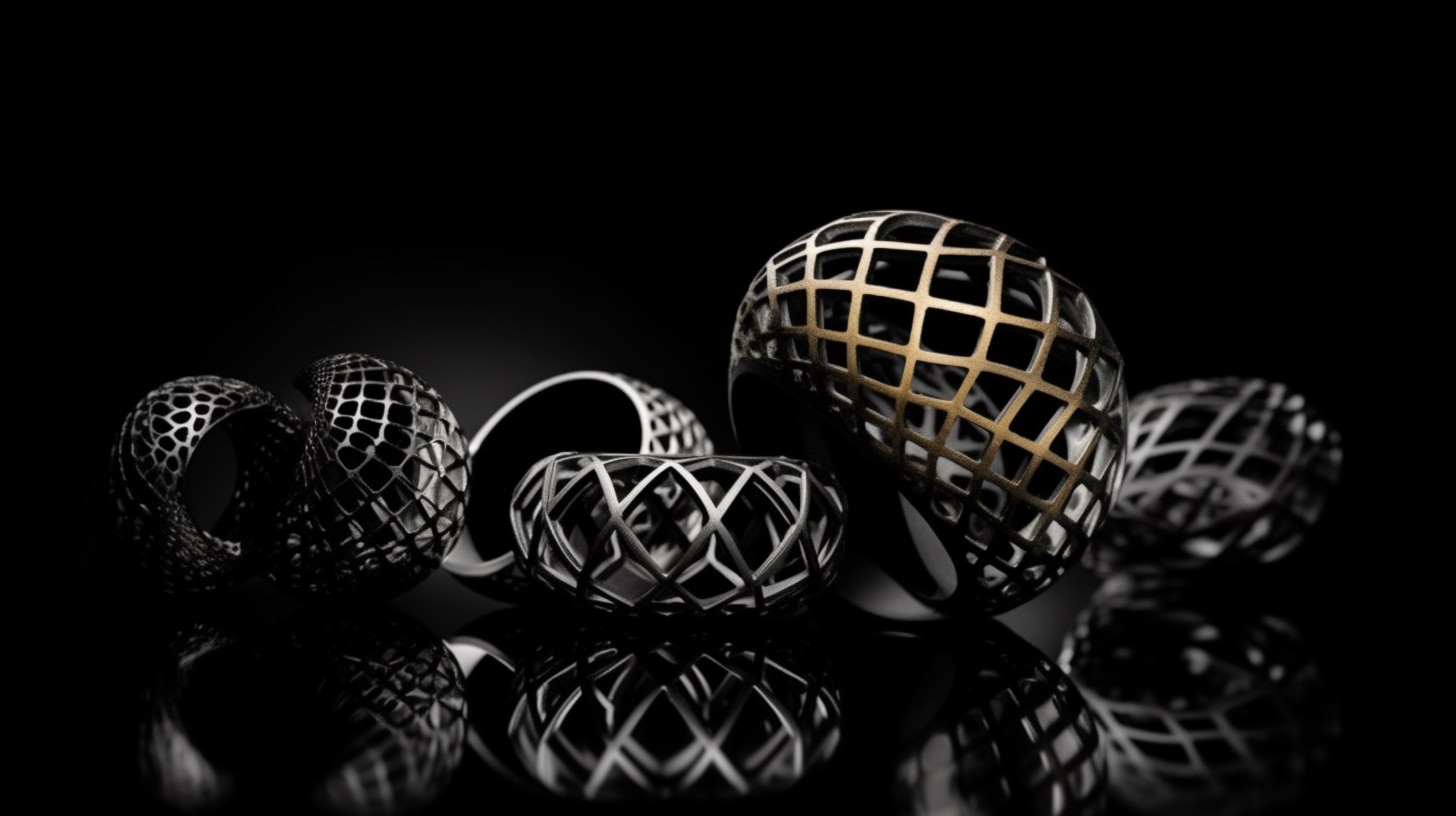
3D printing technology has presented several strategic opportunities for the jewelry industry, including the compression of traditionally analog and craft processes. By directly printing investment casting patterns, creating 3D-printed patterns for mold production, or even using 3D-printed pattern molds, manufacturers can streamline their operations and increase efficiency. The development of custom retail platforms and the ability to mass-customize premium jewelry has given businesses a competitive edge in the market. Furthermore, the geometric complexity achievable with 3D printing has led to new stylistic opportunities and design possibilities, allowing artists to push the boundaries of creativity in their work.
Polymer 3D Printing in Jewelry: Hardware and Materials
Two main technologies dominate the polymer 3D printing landscape for the jewelry market: vat photopolymerization and material jetting. Vat photopolymerization is a process in which a vat of liquid photopolymer resin is selectively cured using a light source, layer by layer, to create the desired object. This technology includes subcategories such as stereolithography (SLA), digital light processing (DLP), and continuous 3D printing.
Material jetting, on the other hand, involves depositing droplets of liquid photopolymer onto a build platform and then curing them with ultraviolet (UV) light. The process is similar to inkjet printing and can create highly detailed, smooth, and accurate parts. Material jetting is especially effective for producing castable wax patterns, which are widely used in the jewelry industry.

Several key players have emerged in the vat photopolymerization space, each offering unique platforms catering to the needs of the jewelry industry. Some of the most notable vendors include Formlabs, with their Form 3 and Form 3L printers, which utilize low-force stereolithography (LFS) technology; EnvisionTEC, which offers a range of DLP-based 3D printers like the Perfactory series; and Carbon, which has developed the innovative Digital Light Synthesis (DLS) technology for continuous 3D printing. These platforms provide jewelers with the ability to create highly detailed and intricate designs, making them ideal for various jewelry applications.
A wide array of vat photopolymerization materials are available for jewelry applications, each with its own unique properties and advantages. Castable resins are among the most popular materials, as they allow for the creation of highly detailed investment casting patterns that can be burned out cleanly during the casting process. These materials often contain wax or other additives that facilitate a smooth burnout, resulting in high-quality castings.
In addition to castable resins, there are materials designed specifically for creating mold patterns, such as those used in vulcanized mold production. These materials typically offer high dimensional accuracy, stability, and surface quality, making them ideal for the production of intricate jewelry pieces. Other vat photopolymerization materials include flexible, tough, and high-temperature resins, which can be used for various applications in the jewelry industry, such as design and fit verification models or the creation of unique wearable pieces.
Metal 3D Printing for Jewelry: Hardware and Materials
The metal 3D printing landscape for the jewelry market is marked by the presence of several key vendors, each offering innovative technologies and solutions. Some of the major players in this space include EOS, which provides a range of direct metal laser sintering (DMLS) systems; SLM Solutions, a pioneer in selective laser melting technology; Desktop Metal, which has developed the Studio System for bound metal deposition (BMD); and ExOne, a leader in binder jetting technology for metal 3D printing. These vendors have developed systems that cater to the unique needs of the jewelry industry, enabling the creation of intricate and high-quality metal pieces.
Binder jetting has emerged as a promising technology for precious metal 3D printing in the jewelry market. In this process, a liquid binder is selectively deposited onto a powder bed of metal particles, layer by layer, to create the desired object. Once the printing process is complete, the part is sintered in a furnace to remove the binder and fuse the metal particles together, resulting in a solid, dense piece.
The advantages of binder jetting for precious metal printing include its ability to produce complex geometries, reduced material waste, and the potential for mass production. Vendors like ExOne and Desktop Metal are pushing the boundaries of binder jetting technology for precious metal printing, offering solutions that can cater to the high-quality requirements of the jewelry industry.
A variety of precious metals can be used in metal 3D printing for the jewelry market, including gold, silver, and platinum. Each metal offers unique properties and aesthetic qualities, making them suitable for different applications and designs.

Gold is a popular choice for 3D-printed jewelry due to its versatility, durability, and timeless appeal. It is available in various alloys, such as yellow, white, and rose gold, providing jewelers with a range of options to suit their designs. Silver, while less expensive than gold, is another popular choice for metal 3D printing in the jewelry market. Its affordability, combined with its attractive luster and excellent thermal conductivity, makes silver an ideal material for creating intricate and detailed pieces.
Platinum, one of the rarest and most valuable metals, is also used in metal 3D printing for the jewelry market. Its high durability, resistance to tarnish, and hypoallergenic properties make it a highly sought-after material for high-end jewelry pieces. As metal 3D printing technologies continue to evolve, the range of materials available for the jewelry market is likely to expand, offering even more possibilities for creating stunning and unique pieces.
3D Printing Jewelry Market Forecast: 2023-2033
The 3D printing jewelry market is expected to experience significant growth over the next decade, driven by advancements in hardware, materials, and software technologies. As the adoption of 3D printing in the jewelry industry continues to increase, hardware shipments and revenues are projected to rise steadily. Both polymer and metal 3D printing systems will see a surge in demand, with a particular emphasis on systems tailored to the unique needs of the jewelry market.
The growth in hardware shipments and revenues can be attributed to various factors, such as the decreasing cost of 3D printers, increased accessibility for small businesses and independent designers, and the development of high-speed polymer and metal printing technologies. These advancements are expected to fuel the expansion of the 3D printing jewelry market and create new opportunities for manufacturers, designers, and consumers alike.
The materials segment of the 3D printing jewelry market is also projected to grow rapidly, with a focus on both polymer and metal materials. As more vendors enter the market and develop innovative materials for 3D printing, jewelers will have access to a wider variety of options, allowing for increased design freedom and enhanced product offerings.
The polymer materials market is expected to benefit from the development of new photopolymers and resins specifically designed for the jewelry industry. These materials will offer improved mechanical properties, increased detail resolution, and enhanced surface finish quality, making them ideal for use in 3D-printed jewelry applications.
The metal materials market will be driven by the development of new alloys and metal powders for binder jetting and other metal 3D printing technologies. These materials will enable jewelers to create intricate, high-quality pieces in precious metals like gold, silver, and platinum, expanding the possibilities for innovative and unique designs.

As the 3D printing jewelry market continues to evolve, there will be a growing demand for specialized services and software tailored to the industry’s unique requirements. This may include design platforms that facilitate the creation of intricate geometries, optimization tools that ensure efficient material usage and high-quality printing, and software solutions that streamline production workflows. The growth in services and software will further enable jewelers to leverage the benefits of 3D printing, ultimately driving the continued expansion of the market.
The 3D printing jewelry market is poised for significant growth over the next decade, with advancements in hardware, materials, services, and software all contributing to the industry’s expansion. As 3D printing technologies become more accessible, affordable, and versatile, jewelers of all sizes will be able to harness the benefits of additive manufacturing to create innovative, high-quality pieces that cater to the evolving tastes of consumers.
The jewelry industry must continue to embrace the possibilities presented by 3D printing and invest in the development and adoption of new technologies. By staying at the forefront of innovation, jewelers can capitalize on the numerous opportunities for growth, increased efficiency, and enhanced design capabilities that 3D printing offers. As the market continues to evolve, those who are willing to adapt and invest in the future of 3D printing will be well-positioned to thrive in the competitive landscape of the jewelry industry.
As the 3D printing jewelry market continues to grow, so too will the opportunities for collaboration and innovation between designers, manufacturers, and consumers. The future of the jewelry industry is undoubtedly intertwined with the continued development of 3D printing technologies, and those who embrace this evolution will play a crucial role in shaping the future of jewelry design and production. With its vast potential for creativity, efficiency, and customization, 3D printing is set to revolutionize the jewelry industry and redefine what is possible in the world of design and manufacturing.