In a groundbreaking collaboration, nTopology, the leading engineering design software developer, and EOS, the industrial 3D printing industry pioneer, have announced a significant breakthrough in additive manufacturing (AM) workflow. The development of a new Implicit Interop capability aims to solve a major bottleneck in the industry by enabling the transfer of highly complex designs in megabyte-sized files, thereby revolutionizing the time to manufacturing.

Traditionally, file sizes for 3D printers could reach tens of gigabytes, posing significant challenges for the manufacturing process. However, nTopology and EOS have now introduced the nTop Implicit File, which can drastically reduce file sizes by up to 99%, generate files 500 times faster, and achieve 60% faster load times. These advancements make the technology more accessible to AM build preparation software, expediting the entire manufacturing workflow.
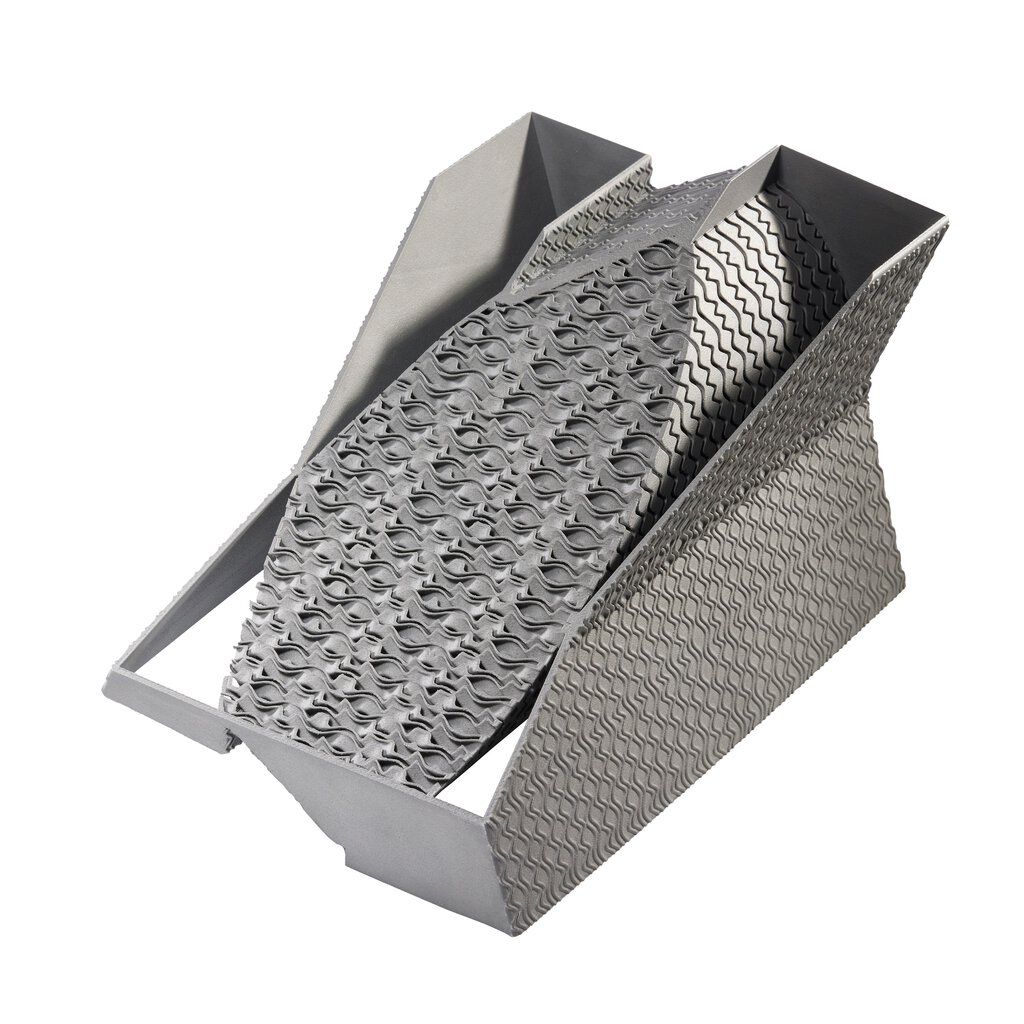
One of the impressive demonstrations at the Formnext 2022 event in Frankfurt, Germany, featured a large industrial heat exchanger, designed by Siemens Energy as a proof-of-concept. The intricate design, exported to an nTop Implicit File within seconds, required less than 1 MB of storage space. The file was then seamlessly imported into EOSPRINT, where it was used to additively manufacture the heat exchanger using an EOS M 290 industrial 3D printer. This successful application showcased the immense potential of the Implicit Interop technology.
To drive broader adoption of their innovation, nTopology and EOS are collaborating with the 3MF Consortium to standardize the Implicit File format. This collaboration aims to incorporate the technology into a future update of the 3MF industry-standard 3D printing file format, further enhancing compatibility and ease of use across the industry.
Bradley Rothenberg, nTopology Co-founder and CEO, expressed the company’s commitment to empowering engineers with design freedom and enabling the production of complex parts. By working closely with EOS, they developed a solution to address the design data bottlenecks encountered in printing intricate designs. This partnership exemplifies their dedication to advancing the industry and fostering collaborations with original equipment manufacturers (OEMs).

Alexander Bockstaller, Software Product Line Manager at EOS, acknowledged the rising complexity of part geometries due to modern design approaches like topology optimization, generative design, and design for additive manufacturing (DfAM). These advancements have necessitated a solution to handle large and intricate meshes more efficiently. EOS takes up the challenge by driving the standardization of implicit geometry representation, making it possible to build designs that were previously unattainable.
Ole Geisen, Head of Engineering Services for Additive Manufacturing at Siemens Energy, applauded the technical development achieved by nTopology and EOS. He emphasized that the rest of the additive manufacturing ecosystem now needs to catch up with these advancements. As topology optimization, generative design, and DfAM continue to push the boundaries of complexity in part geometries, exchanging such intricate designs using traditional data formats becomes increasingly challenging. The Implicit Interop technology is a game-changer, removing a significant barrier and paving the way for innovation in thermal management and beyond.
The introduction of the Implicit Interop capability by nTopology and EOS marks a pivotal moment in the additive manufacturing industry. This technological breakthrough not only addresses the long-standing bottleneck of handling large file sizes but also unlocks new possibilities for engineers and designers to create complex and innovative products. As the implicit geometry representation becomes standardized, the industry can expect improved interoperability, streamlined workflows, and accelerated adoption of advanced design techniques. With continued collaborations and advancements, the future of additive manufacturing looks promising and full of exciting opportunities.